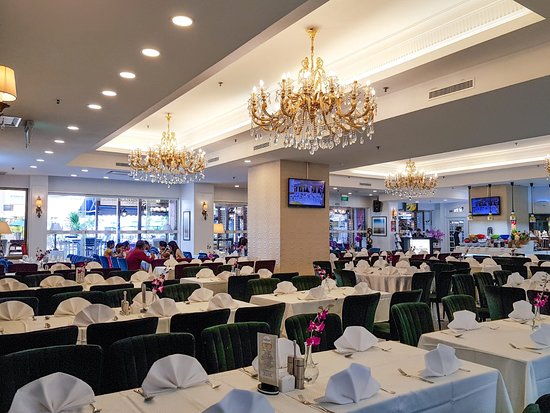
Choosing an event venue in Singapore is rarely just a matter of finding a room that looks good and fits the budget. The venue affects how easily guests arrive, how comfortably they move around, whether the programme runs on time, how food is served, how clearly presentations are heard and even how much additional coordination you need to handle yourself.
A venue that appears affordable at first can become expensive once audiovisual equipment, furniture, extended hours, décor, parking and other essentials are added. Likewise, a beautiful ballroom can be the wrong choice if its layout creates poor sightlines or leaves too little room for registration and buffet queues.
Whether you are organising a wedding, corporate seminar, product launch, birthday celebration or company dinner, the following considerations will help you choose an event venue in Singapore based on how well it will actually work on the day.
Match the Venue Capacity to Your Event Format, Not Just Your Guest Count
Capacity should be one of the first things you confirm, but the maximum number advertised by a venue does not tell the whole story.
A room that accommodates 150 people for a standing reception may hold considerably fewer guests when arranged with banquet tables, a stage, buffet stations or theatre-style seating. Always ask for capacity based on the exact configuration you intend to use.
For example, The Landmark’s event venue options illustrate how significantly capacity changes according to layout. Red Velvet is listed for 180 guests standing, 150 seated and 120 in theatre style. Sapphire accommodates 120 standing, 100 seated or 80 theatre-style guests, while The Landmark Ballroom is listed for 280 standing, 250 seated and 200 in theatre configuration.
Think About Usable Space, Not Maximum Space
Your guests are not the only people and objects taking up room. Depending on the event, you may also need space for:
registration, a stage, an aisle, photographers, AV equipment, buffet stations, a reception table, entertainment, a photo area or a VIP holding space.
A 200-person room therefore does not automatically make a comfortable venue for a 200-person banquet.
For larger events, also confirm that the proposed configuration is within the venue’s permitted occupancy and maintains proper emergency access. Singapore’s SCDF Fire Code includes specific requirements for exits and circulation in assembly spaces, so guest capacity should never be increased simply by squeezing in additional tables.
Choose a Location That Makes Attendance Easy
A convenient venue improves more than guest satisfaction. It can reduce late arrivals, simplify vendor coordination and make the event more accessible to people coming from different parts of Singapore.
Instead of judging location by whether an address appears “central”, consider the entire guest journey.
For public-transport users, check the walking distance from the nearest MRT station and whether the route is easy to understand. For drivers, look at parking availability and how guests get from the car park to the event space. Older guests, families with young children and attendees carrying equipment may also value a convenient taxi or ride-hailing drop-off point.
The Landmark, for instance, is located inside Village Hotel Bugis at 390 Victoria Street. Its contact and directions page states that it is about a five-minute walk from Bugis MRT, provides several nearby bus options and has parking facilities at the property.
Consider Singapore’s Weather When Assessing Access
A five-minute walk feels very different during heavy rain or midday heat. When inspecting a venue, check whether guests can reach the entrance through sheltered walkways or whether there is a covered drop-off area.
This becomes particularly important when your event uses an outdoor, poolside or partially open-air area. Ask what happens if weather conditions make the planned space unusable and whether an indoor alternative is guaranteed rather than merely subject to availability.
Make Food Inclusivity Part of the Venue Decision
For many Singapore events, catering is not a separate consideration from venue selection. Weddings, family celebrations and corporate functions often bring together guests with different cultural, religious and dietary requirements.
Start by understanding who will be attending. You may need to accommodate halal requirements, vegetarian guests, food allergies, children or elderly guests who prefer familiar dishes.
For events involving Muslim guests, it is particularly helpful to distinguish between general “Muslim-friendly” claims and formal halal certification. MUIS administers Singapore’s halal certification system and maintains information for consumers on halal-certified establishments.
The Landmark publicly highlights its MUIS halal certification and serves a broad international selection that includes local, Indian, Mediterranean, Western and Asian dishes. Hosts considering a mixed-group event can review its halal buffet and dining options when assessing whether the menu offers enough variety for their audience.
Look Beyond the Menu and Study the Service Format
Food quality matters, but event flow matters too.
For a short corporate lunch, fast buffet access may be more useful than an elaborate dining experience. At a wedding, several buffet points may be needed so that hundreds of guests are not waiting in one queue. A networking event may work better with food that guests can comfortably eat while standing and talking.
During your site visit, ask where food stations will physically be located. A good menu cannot compensate for poor circulation.
Compare the Total Event Cost, Not the Headline Venue Price
Two venue quotations can appear similar while offering very different levels of value.
One package might include basic AV equipment, seating, staging and room setup. Another could charge separately for each of those items. A lower per-person price can therefore cost more by the time the event is fully equipped.
When reviewing quotations, clarify:
- Whether the price is nett or subject to service charge and GST.
- Exactly how many hours of venue usage are included, including setup and teardown.
- Whether tables, chairs, linen, stage, microphones, projector, screen and Wi-Fi are included.
- Whether parking support, food tasting, signage or registration furniture is provided.
- What overtime, additional AV, external vendor, cleaning or corkage charges may apply.
- Whether minimum attendance or minimum spending requirements apply.
- What happens to the price if your final guaranteed attendance changes.
The Landmark’s event space and package information is a useful example of why package inclusions should be considered alongside the room itself. Its event offerings combine venue space with catering and meeting-related facilities, although organisers should always request a current quotation because package inclusions and pricing can change.
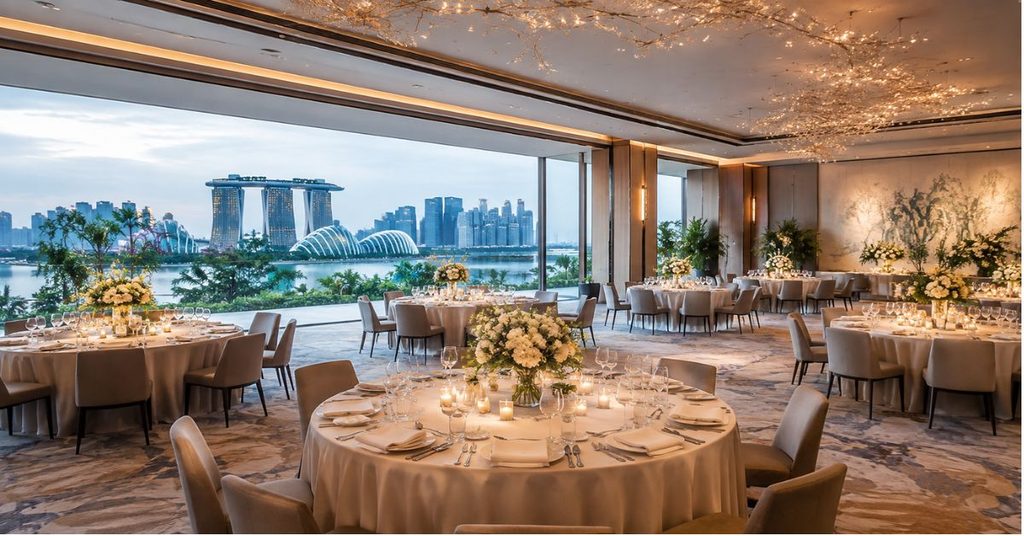
Test the Venue’s AV and Technical Infrastructure
For a seminar or conference, unreliable technology can undermine an otherwise excellent venue.
Do not simply ask, “Do you have a projector?” Ask what equipment is available, whether it is included in your package and whether it supports your actual programme.
A corporate presentation may require multiple microphones, reliable Wi-Fi, laptop connectivity, screens visible from the back of the room and an operator who can respond quickly if something fails. Product launches and award ceremonies can need significantly more sophisticated lighting, audio and presentation equipment.
The Landmark’s seminar materials, for example, list projectors, screens, cordless microphones, Wi-Fi and a basic AV sound system among the meeting facilities provided with certain packages. Its seminar arrangements also support cluster, theatre and classroom configurations.
That kind of built-in infrastructure can remove several separate vendors from your planning process.
Ask for an Actual Technical Test
If your programme depends heavily on presentations, video or sound, arrange a technical walkthrough before event day.
Connect the laptop you intend to use. Stand at the back of the room while someone speaks into the microphone. Check the screen from different seats. Test video playback and internet connectivity.
Technical problems are much easier to solve during a rehearsal than while 150 guests are watching.
Examine the Layout From the Guest’s Point of View
Floor plans tell you dimensions. A site visit tells you how the event will feel.
Walk through the venue in the same sequence your guests will experience it: arrival, registration, entry, seating, food service, toilets and departure.
For a corporate event, look at whether attendees can enter without interrupting a presentation. For a wedding, make sure guests can see the couple, stage and important ceremonial moments without standing up repeatedly. For networking events, avoid filling every square metre with furniture; people need space to move and form conversation groups naturally.
The shape of the room matters as much as its area. Columns, low ceilings, deep corners or badly positioned screens can make a technically large room feel smaller.
It is often better to choose a slightly smaller venue with excellent flow than a larger venue where significant areas are difficult to use.
Make Accessibility and Multigenerational Comfort a Priority
Accessibility should be considered from the beginning rather than addressed only when a guest asks about it.
Singapore’s Building and Construction Authority emphasises accessible entrances, toilets and barrier-free routes as important features of an inclusive built environment.
During your venue inspection, consider whether a wheelchair user can travel from the drop-off point or car park to the ballroom without encountering stairs. Check lift access, accessible toilets and the distance elderly guests will need to walk.
Comfort also includes details that are not strictly accessibility features. Are there places for older guests to sit before the ballroom opens? Are the toilets nearby? Is the air-conditioning comfortable once the room is full? Can parents with prams move easily between tables?
These questions are especially important for weddings and family celebrations where guests may range from young children to grandparents.
Understand What the Venue Allows Before Signing
A venue may fit your budget and guest count but still conflict with your plans because of operating restrictions.
This is especially relevant if you are bringing in external decorators, photographers, entertainers, caterers or production companies.
Before paying a deposit, confirm practical questions such as:
- When can vendors begin loading in and when must everything be removed?
- Is there a separate service lift or loading area?
- Can you use external AV, décor or entertainment vendors?
- Are there restrictions on installations, hanging decorations or stage structures?
- Is rehearsal time included?
- Is storage available before or after the event?
- Are there restrictions on music volume or event finishing time?
- Who is responsible for last-minute layout changes?
- What backup arrangements apply if part of the event is outdoors?
Judge the Event Team as Carefully as the Room
You are not really booking an empty space. You are relying on the venue’s team to help translate your plans into an actual event.
Pay attention to the quality of communication before you book.
Does the coordinator answer detailed questions clearly? Do they identify potential problems with your proposed layout? Are commitments recorded in writing? Do they explain what is included instead of simply saying everything can be arranged?
An experienced coordinator should be able to discuss realistic timing for registration, meal service, speeches, room turnover and vendor setup.
This becomes particularly valuable when plans change. A guest-count increase, delayed vendor or last-minute dietary request is much easier to manage when the venue team understands both the space and the programme.
Make Your Final Decision With a Site Visit, Not Photographs Alone
Professional photographs are designed to show a venue at its best. They cannot tell you whether guests will queue outside the ballroom, whether the screen is difficult to see from one corner or whether buffet stations block the main entrance.
Once you have shortlisted two or three venues, visit each one with the same proposed event format in mind.
Evaluate capacity, transport, catering, facilities, accessibility, package value and service separately rather than allowing one impressive feature to dominate your decision. A venue with spectacular décor but poor guest access may be less suitable than a simpler space that removes logistical problems throughout the day.
Whenever possible, ask to see the venue configured for an event similar to yours. Seeing a ballroom with tables, stage equipment and catering stations in place gives you a much more realistic sense of usable space than viewing an empty room.
Conclusion
The right event venue in Singapore is not necessarily the largest, most luxurious or least expensive option. It is the venue that supports the way your particular event needs to work.
Start with a realistic guest count and layout. Then consider how people will reach the venue, whether the food works for your audience, what the package genuinely includes, whether the AV setup supports your programme and how comfortably guests can move through the space. Accessibility, vendor rules, weather contingencies and the quality of the venue’s event team should influence the decision just as much as décor.
Venues that combine flexible spaces, inclusive dining, convenient access and built-in event support are likely to become increasingly valuable to organisers who want to reduce unnecessary complexity. The goal is not simply to find somewhere to hold an event; it is to choose a venue that removes problems before your guests ever notice them.
FAQs
What should I check first when choosing an event venue in Singapore?
Confirm your realistic guest count, event format and preferred date first. These determine the room size, seating configuration and type of venue you actually need.
Should I book a larger venue than my expected guest count?
Not automatically. Too much empty space can weaken the atmosphere, while a crowded room affects comfort and movement. Choose according to the proposed seating, stage, catering and circulation requirements rather than maximum room capacity alone.
What does “++” mean on a Singapore event venue quotation?
It generally means the advertised price is subject to additional service charge and GST. Ask the venue for the final estimated payable amount so quotations can be compared fairly.
How do I know whether a venue is suitable for Muslim guests?
Check whether the food provider holds current MUIS halal certification rather than relying only on terms such as “halal-friendly”. You should also ask about prayer arrangements if they are important for your event.