Renting an event space sounds straightforward until the small details start turning into expensive problems. A room that looked perfect online may feel cramped once you add a stage, registration tables, a buffet line, or camera equipment. A package that looked affordable may not include the AV support, setup time, or catering flexibility you assumed it did. And in Singapore, venue choices can also intersect with fire-safety rules, accessibility expectations, liquor or entertainment licensing, and venue-specific operating conditions.
That is why smart venue selection is less about “finding a nice place” and more about matching the space to the event you are actually running. Landmark is a useful example of how much these details matter: its event page highlights seminar packages, AV support, stationery, catering options, multiple function spaces, a central Bugis location, and parking. Those are all practical advantages, but only if they fit your guest profile, event format, and timeline.
Choosing a venue by appearance instead of event fit
A polished ballroom or stylish function room can be a bad hire if it does not support the way your event needs to flow. The mistake here is treating venue selection like an interior-design decision when it is really an operations decision.
Capacity is a layout question, not just a guest-count question
One of the most common booking mistakes is asking only, “How many people can this venue hold?” The better question is, “How many people can this venue hold in my layout?” Singapore’s fire code for assembly occupancies ties exit requirements and corridor widths to occupant load. For example, once assembly occupancy moves into the 51 to 200 range, the code calls for at least two doors and minimum corridor width requirements; SCDF also notes that rows with more than 30 seats may require prior consultation because of potential congestion. That means seating style, aisle widths, and movement paths matter just as much as raw floor area.
A practical example: a venue may comfortably hold 150 people in theater style, but that does not mean it will work for 150 people seated classroom-style with breakout tables, a lectern, sponsor backdrop, and refreshment station. Even a venue’s own published numbers can vary sharply by setup. D’Marquee, for instance, lists a maximum of 2,200 guests for theatre style but 1,230 for banquet style. If you book based on the higher number without locking in the layout first, you are already planning on the wrong assumptions.
Guest access matters before guests even enter the room
Another mistake is focusing on the function room and forgetting the arrival experience. In Singapore, accessibility is not a minor detail. BCA’s Code on Accessibility sets baseline requirements for accessible buildings for persons with disabilities, the elderly, and families with young children. For event planners, that means it is worth checking barrier-free access, lift access, drop-off convenience, and whether elderly guests or wheelchair users can move through the venue comfortably without improvisation.
This is also where location becomes part of the event experience. Landmark explicitly positions its venue around proximity to CBD areas and large parking availability, which signals the right kind of practical thinking: guest convenience affects punctuality, turnout, and the overall tone of the event. A venue can be beautiful and still be the wrong choice if guests struggle with arrival, access, or navigation.
Assuming the package includes everything you need
Package pricing often creates false confidence. Planners see a per-person or room rate and assume the essentials are covered. In reality, what is included can differ widely from one venue to another, even when the package names sound similar.
Landmark’s corporate event page is useful because it spells out what its seminar package is designed to cover: flipcharts and markers, advanced audio-visual systems, notepads, and optional high tea, snacks, and corporate lunch, all across multiple event spaces. That level of detail is helpful, but it also shows why you should never compare venues on headline price alone. One package may include the tools needed for a seminar; another may charge extra for the same items or treat them as optional add-ons.
This becomes even more important when food expectations are part of the brief. If your audience includes Muslim guests, “menu flexibility” is not the same thing as halal assurance. MUIS is the sole legal authority issuing halal certificates in Singapore, and Landmark specifically markets halal event spaces while referencing MUIS certification on its site. If halal suitability matters for your event, verify the certification status rather than relying on assumptions or verbal assurances.
A good planner compares inclusions with ruthless clarity: room access hours, AV hardware, AV operator support, Wi-Fi expectations, meal format, dietary handling, linen and furniture, signage rights, and whether setup manpower is included or separate. The cheapest quote often stops being the cheapest once all the real operating needs are priced in.
Leaving permits and venue-use rules until the last minute
A surprising number of event problems have nothing to do with décor or catering. They happen because the organiser assumed that if the venue accepted the booking, every other approval would automatically fall into place. In Singapore, that is a risky assumption.
GoBusiness provides an e-Adviser for Events precisely because permit requirements vary by event type. If your event includes live entertainment, alcohol service, or temporary food sales, do not wait until the final week to figure out what applies.
Here are the issues that commonly get missed:
- Live performances, DJs, screenings, or other entertainment: SPF states that a Public Entertainment or Arts Entertainment licence is required to provide entertainment unless an exemption applies. The application process also requires certain supporting documents, including planning permission on the land use of the premises.
- Alcohol service: SPF states that a liquor licence is required if a company, business, or society intends to supply liquor, unless exempted. It also makes clear that liquor and public-entertainment approvals are governed by separate frameworks, so one approval does not guarantee the other.
- Pop-up food stalls or food handling for sale: SFA says a temporary fair permit is needed when the event is in a private venue and there is handling of food for sale, and each individual stall preparing food or beverages for sale also requires a licence handled through the fair operator.
- Unclear cases: Use the GoBusiness e-Adviser early instead of guessing. It exists to identify the licences and permits an event may need.
The mistake is not simply forgetting a licence. The deeper mistake is failing to match your event concept to the venue’s permitted use from the start. If your room booking assumes speeches and lunch, but your final program adds a live band, liquor sales, and pop-up food booths, you may have created a completely different compliance picture.
Ignoring setup time, teardown time, and vendor logistics
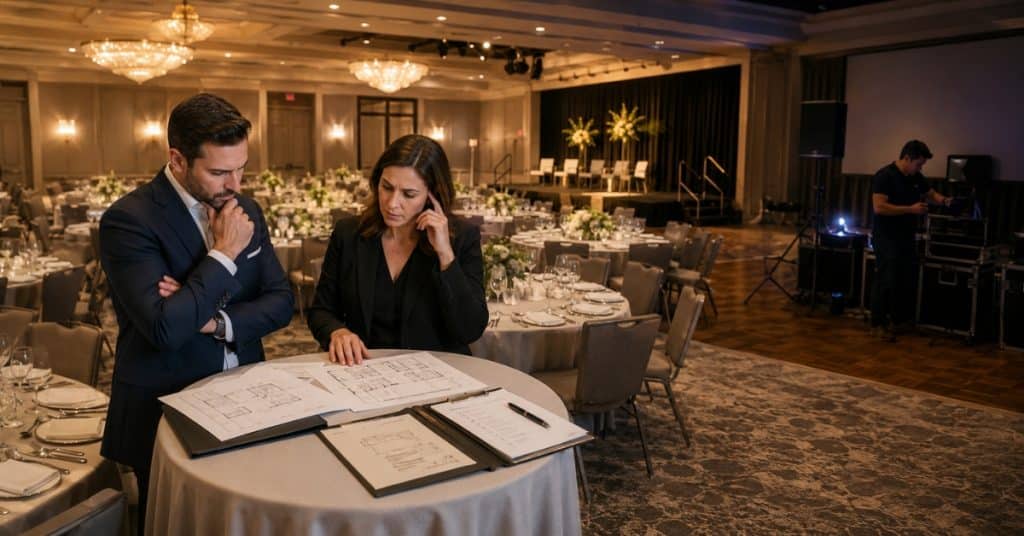
Many organisers budget only for the hours when guests are in the room. Venues, however, usually care about the full access window: load-in, soundcheck, setup, guest time, teardown, and final clearance.
D’Marquee’s published venue rules make this very clear. Clients and vendors may access the venue only during the contracted time period, extra setup and teardown time must be arranged in advance, and events must conclude by the agreed end time to avoid overtime charges. The same rules also require floor plans, layouts, and special equipment setups to be submitted for approval before the event.
This is where event budgets quietly get wrecked. A program that ends at 9:30 p.m. may still trigger additional costs if teardown runs long, if a vendor arrives early without approved access, or if the layout needs last-minute adjustments. The most avoidable mistake is booking only the “show time” and forgetting the non-negotiable hours around it.
A simple rule helps here: if a supplier needs the space, that time belongs in the booking. That includes rehearsal, soundcheck, cable runs, décor installation, photography setup, and final pack-down. If those hours are not written into the agreement, assume they are not free.
Skimming the contract instead of stress-testing it
The contract is where venue risk becomes real. Many renters read the price, payment schedule, and event date, then skim past the clauses that matter most when something changes.
One useful example comes from Arts House venue materials, which state that the booking may be cancelled with no refund or compensation if required licences and permits are not received by the stated deadline. That is a strong reminder that missing documentation can cost more than admin time; it can cost the booking itself.
This is why verbal assurances are never enough. If the venue team says external décor is fine, ask what materials are prohibited. If they say AV is available, confirm whether operators are included. If they say the date can be changed, ask what the rescheduling terms are. If they say the package is flexible, get the revised scope in writing.
Before you pay the deposit, make sure the contract answers these questions clearly:
- What exactly is included in the booking price, and what triggers extra charges? Use the venue’s written package scope, not assumptions based on the sales conversation.
- Are setup and teardown inside your booked hours? If not, ask for the full access window in writing.
- Does your event concept trigger additional approvals or licences? Do not separate the venue contract from permit planning.
- Are there approval requirements for floor plans, décor, or equipment? Some venues require these to be submitted before the event.
- What happens if guest numbers, event timing or catering scope changes? If the answer is not written down, it is not settled.**
That last point is not just legal caution. It is operational discipline.
Building a smarter shortlist before you commit
The best way to avoid venue mistakes is to filter options through the event brief, not the other way around. A good shortlist is not the three prettiest spaces. It is the three spaces that still make sense after you test layout, accessibility, catering fit, licensing exposure, and booking conditions.
A strong shortlist usually answers these questions before the site visit: Does the venue support the event format? Does the audience profile require barrier-free access or halal-certified catering? Are the package inclusions actually aligned with the event? Could the final program trigger entertainment, liquor, or temporary food approvals? And are the access windows long enough for real setup and teardown, not just guest-facing time? Landmark’s clearer package listing is a good example of what useful venue information looks like, but every shortlisted space should be evaluated with the same level of scrutiny.
Conclusion
Most venue booking mistakes do not come from bad taste. They come from incomplete thinking. Organisers focus on the room, then discover too late that the real pressure points were layout, arrival flow, accessibility, package scope, permit requirements, setup windows, and contract terms. In Singapore, those details are not side issues; they are part of whether the event can run smoothly in the first place.
The future of smarter venue selection is also becoming clearer. Guests expect easier access, businesses expect clearer package value, and planners increasingly need confidence around food assurance and operational reliability. Venues that can show that clarity upfront will stand out. For renters, the takeaway is simple: do not book the room first and solve the details later. Solve the details first, then book the room that can actually support them.
FAQs
How do I know whether a venue is really big enough for my event?
Do not rely on the headline capacity alone. Check the setup style, circulation space, stage needs, buffet or registration footprint, and any fire-safety constraints tied to occupant load and exit width. A theatre-style capacity can be very different from a banquet-style capacity.
Do I need a liquor licence for a private event in Singapore?
If your company, business, or society intends to supply liquor, SPF says a liquor licence is required unless an exemption applies. Also, liquor approval is separate from public-entertainment approval.
If the venue has music or a stage, does that mean my event is automatically covered?
No. SPF states that a Public Entertainment or Arts Entertainment licence is required to provide entertainment unless exempted, and the application process can depend on the premises and supporting documents. Do not assume the room booking covers the programme.
What should I check if my guests need halal catering?
Verify halal status properly. MUIS is Singapore’s legal halal-certifying authority, and if halal assurance matters, you should confirm certification rather than assuming a venue can simply prepare halal food. Landmark is one example of a venue that explicitly markets halal event spaces.
Is setup and teardown usually included in the rental period?
Not always. Some venues state clearly that access is limited to the contracted time period, with extra setup and teardown time needing advance arrangement and overtime charges applying if the event runs late. Confirm this before paying the deposit.
