
A conference venue can make a strong agenda feel polished and effortless, or turn a well-planned event into a stressful day of delays, tech issues, and frustrated guests. That is why venue selection is never just about square footage. For organizers, the real question is whether the space can support registration, speaking sessions, networking, meals, accessibility needs, livestreams, and the simple logistics that keep the day moving. In Singapore, where the MICE sector continues to grow and the country remains one of the region’s leading business events destinations, these practical details matter even more because attendee expectations are high and competition is strong.
A good local example is Landmark Bugis. Its corporate event packages highlight exactly what experienced planners usually check for first: seminar essentials such as flipcharts, markers, advanced audio-visual systems, and notepads, along with catering options, three event spaces, privacy, proximity to the CBD, and large parking facilities. Those are not “extra perks.” They are the basics that help a conference run smoothly.
Why conference facilities matter in Singapore
The best conference venues act like operational partners, not just rental spaces. A venue that can support multiple room setups, dependable connectivity, food service, and smooth arrival logistics reduces hidden friction for organizers and gives attendees a better overall experience. That matters in Singapore’s business events market, where venues are part of a broader ecosystem of hotels, transport nodes, dining, and city access.
This standard is also rising. Singapore Tourism Board and industry partners have been pushing stronger sustainability and operational benchmarks through the Singapore MICE Sustainability Certification framework, while several major venues have already earned recognized certifications. In other words, venue quality in Singapore is increasingly judged by how well a property performs across the full event journey, not only by how impressive the ballroom looks in photos.
Flexible spaces that work for real programs
A serious conference rarely runs in one room from start to finish. Most business events need a main plenary space, smaller rooms for breakout sessions, an area for registration, and places where speakers, sponsors, or VIP guests can prepare privately. This is why flexible layouts matter so much. Marina Bay Sands, for example, promotes a mix of meeting rooms, junior ballrooms, and larger ballrooms that can be divided for simultaneous meetings, while Suntec emphasizes space designed for flexibility, functionality, and convertibility across different event formats.
In practical terms, this flexibility protects the program. If a leadership summit starts with a keynote, moves into parallel workshops, then ends with a networking reception, the venue should support all three stages without forcing attendees to move awkwardly between unrelated spaces. Landmark’s three event spaces and fully equipped ballrooms are a useful example of this kind of planning-friendly setup, especially for seminars, corporate meetings, and official conferences.
Privacy is another often-overlooked part of space planning. Board meetings, internal town halls, media briefings, and client presentations do not always belong in an open, high-traffic environment. A venue that can offer private meeting areas alongside public conference zones gives organizers much more control over the tone of the event. Landmark explicitly highlights privacy as part of its corporate event offering, which is especially relevant for formal business functions.
AV, Wi-Fi, and hybrid capability
If there is one facility category that attendees notice immediately, it is technology. Weak microphones, poor projection, unstable Wi-Fi, or missing technical support can disrupt a conference faster than almost anything else. That is why strong AV and connectivity should be considered standard, not premium. Landmark includes advanced audio-visual systems in its seminar package, while Suntec highlights a wide range of AV services with on-site technical assistance and high-speed, high-density Wi-Fi that supports up to 8,000 concurrent connections.
For organizers, the key point is reliability. A room may look impressive, but if the speaker cannot switch smoothly between presentations, if attendees cannot log in during a workshop, or if the event app stops functioning at peak traffic, the entire experience feels disorganized. Venues that actively describe technical support and capacity-backed Wi-Fi are usually more prepared for real conference conditions than venues that only mention “modern facilities” in broad terms.
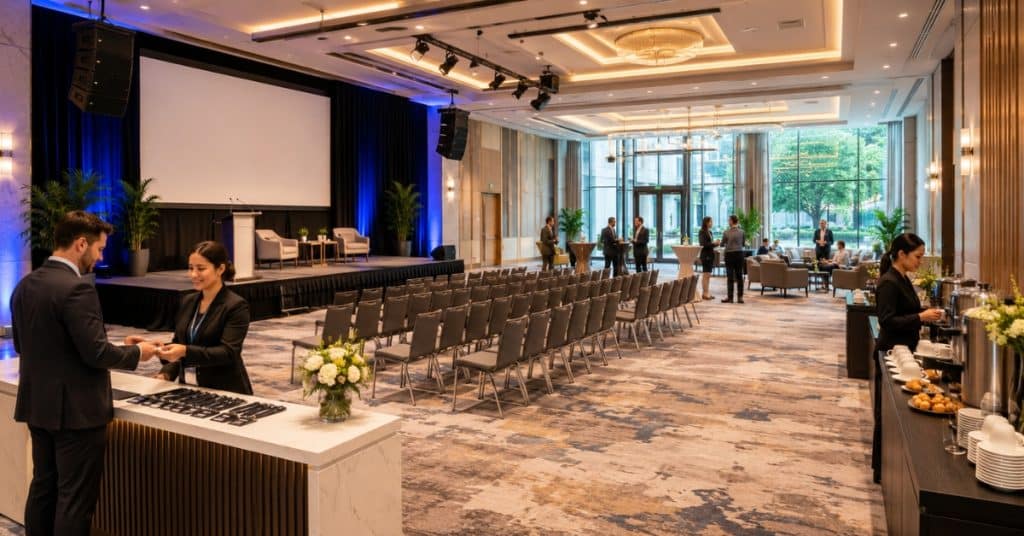
A strong baseline tech package should include
- Included AV services with on-site technical assistance, so organizers are not scrambling for outside help on event day.
- High-speed, high-density Wi-Fi that is designed for large groups rather than casual guest traffic.
- Seminar essentials such as flipcharts, markers, and notepads for workshops, training sessions, and classroom-style events.
- A hybrid or streaming-ready option for remote speakers, overseas stakeholders, or partial virtual attendance.
Hybrid capability still deserves attention even when the event is primarily in person. Marina Bay Sands continues to position hybrid and virtual meeting infrastructure as part of its venue offering, including a customizable virtual platform and a hybrid studio with advanced technical capabilities. For organizers, that means more flexibility when a speaker joins remotely, a regional team wants livestream access, or post-event content needs to be repurposed into digital assets.
Accessibility, safety, and attendee comfort
A conference venue should work for every guest who enters it, not only for the average attendee. In Singapore, accessibility is not a vague aspiration. BCA’s Code on Accessibility is designed to integrate accessibility and usability into building design, creating a safer and more inclusive environment, and the baseline legislation requires at least one wheelchair-accessible toilet and a barrier-free route connecting the accessible entrance and toilet.
That matters because accessibility affects the real usability of the event. A venue may have a premium location and excellent branding, but if a wheelchair user struggles to reach the function room comfortably, if a nursing mother has no practical support spaces, or if elderly guests find the circulation difficult, the event experience immediately becomes exclusionary. Singapore’s updated accessibility code specifically notes enhanced provisions for persons with disabilities, the elderly, and nursing mothers, which shows how venue expectations are evolving beyond box-ticking compliance.
Safety is equally non-negotiable. SCDF’s Fire Code requires means of escape, and it states that required exits must be kept readily accessible, with doors openable and unobstructed during occupancy. For conference organizers, this translates into a simple standard: the venue should never make evacuation an afterthought. When hundreds of people are moving between sessions, queueing at registration, or gathering outside a ballroom, safe circulation and clearly managed exits are essential.
Comfort also sits inside this same category. Attendees may not compliment good circulation, clear wayfinding, or easy restroom access, but they notice immediately when those basics fail. The best venues make comfort invisible by getting the details right from the start. That is often what separates a venue that feels “premium” from one that merely looks polished in marketing photos.
Catering, hospitality, and support services
Food service has a bigger effect on conference quality than many organizers expect. A half-day seminar may only need coffee and light refreshments, but a full-day conference usually needs well-timed breaks, lunch planning, and menu options that match the audience profile. Landmark’s seminar offering includes high tea, snacks, and corporate lunch, while its event page also lists international and Chinese buffet options. Suntec similarly emphasizes a broad culinary range across local and international dishes, and Marina Bay Sands positions dining as part of the integrated event experience.
This is especially important in Singapore, where business events often host diverse attendee groups from different industries, countries, and dietary backgrounds. A venue that can handle meal timing, menu variety, and service flow internally saves organizers from stitching together multiple external vendors. Landmark’s halal-certified positioning is also an important example of inclusive planning, especially for organizations that want one venue that can comfortably accommodate a broader guest base without complicated workarounds.
Good hospitality also extends beyond meals. Organizers benefit from venues that can support technical troubleshooting, guest guidance, room turnover, and last-minute changes without drama. Suntec highlights conference management and exhibition services alongside Wi-Fi and AV, while Marina Bay Sands emphasizes logistical support and expert technical assistance. Those capabilities may not appear in the final event photo gallery, but they often determine whether the day feels calm or chaotic behind the scenes.
Location, parking, and transport convenience
Even an excellent venue can lose points if guests struggle to reach it. In Singapore, access matters because conferences often involve a mix of local professionals, overseas delegates, vendors, speakers, and corporate guests arriving on different schedules. Landmark highlights proximity to CBD areas and large parking space, which is a practical advantage for business events where drive-in access still matters.
Public transport and surrounding infrastructure matter just as much. Suntec describes itself as being in the heart of the CBD with strong integration into transportation nodes, hotels, retail outlets, and entertainment venues. Marina Bay Sands similarly emphasizes a central location, a train station at its doorstep, and direct connectivity through Bayfront MRT, along with multiple pick-up and drop-off points. For event planners, this kind of accessibility improves punctuality, reduces attendee stress, and makes post-event networking or client hosting much easier.
A well-located venue also helps the event feel bigger than the room itself. When guests can move easily from airport to hotel to conference hall to dinner location, the entire event feels more seamless and more professionally organized. That is one reason integrated venues continue to perform strongly in Singapore’s meetings market.
Final thoughts
The essential facilities of a conference venue are the ones that remove friction before attendees ever notice them. Flexible rooms keep the agenda flowing. Strong AV and Wi-Fi protect the content. Accessibility and safety make the event usable for everyone. Catering and support services maintain energy throughout the day. And a central, easy-to-reach location improves both attendance and overall perception. In Singapore, these features are no longer optional extras; they are part of the standard organizers should expect, especially as venue quality is increasingly shaped by stronger accessibility expectations, operational professionalism, and sustainability benchmarks.
For businesses choosing a venue, the smartest approach is to look beyond décor and ask a simple question: can this space support the full event journey from arrival to closing remarks? If the answer is yes, the venue becomes a strategic asset rather than just a place to rent. Landmark Bugis is a useful local example because its offering combines many of the essentials conference organizers actually need: seminar tools, AV, catering, multiple event spaces, privacy, parking, and central-city convenience.
Quick checklist before you book
- Can the venue handle both plenary sessions and smaller breakouts without awkward room changes?
- Are AV services, Wi-Fi, and technical support clearly included in the package?
- Does the venue provide barrier-free access and an accessible toilet?
- Are exits readily accessible and unobstructed during occupancy?
- Can the venue manage meals, refreshments, and practical guest support on-site?
- Is it easy to reach by MRT, car, and drop-off, especially for business guests on tight schedules?
FAQs
What is the most important facility in a conference venue?
There is no single winner, but dependable AV and Wi-Fi are often the first non-negotiables because they affect presentations, attendee engagement, and event flow immediately. Flexible room layout comes very close behind.
Why are breakout rooms important for conferences?
Breakout rooms allow workshops, side meetings, speaker prep, and parallel sessions to happen without disrupting the main program. They make the venue more useful for real conference formats, not just one-stage events.
Should conference venues provide catering in-house?
In most cases, yes. In-house catering simplifies scheduling, service flow, and menu coordination, especially for full-day events and mixed guest groups.
What accessibility features should every venue have?
At minimum, there should be a barrier-free route and at least one wheelchair-accessible toilet, in line with Singapore’s accessibility requirements.
Does location really matter if the venue itself is good?
Absolutely. Easy access by MRT, car, and drop-off improves punctuality, guest convenience, and overall event experience, especially in a fast-moving business city like Singapore.