Choosing a private event venue is easy to underestimate. On paper, many venues look similar: a ballroom, a per-person package, a convenient address, a few photos and a contact form. In reality, the venue shapes almost everything your guests will remember how easy it was to get there, whether the room felt cramped or comfortable, whether speeches were actually audible, whether the food worked for everyone in the room, and whether the event stayed on budget once the final bill arrived. That is why venue comparison should never start with price alone. It should start with fit. In Singapore especially, practical details such as MRT access, traffic flow, catering rules, halal requirements, and venue licensing can make the difference between a smooth event and a stressful one.
Start with the event you are actually hosting
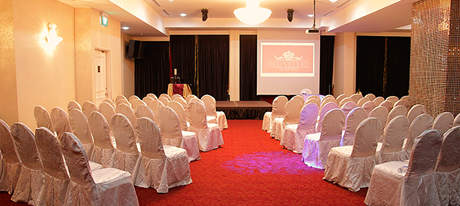
A good venue is not simply a “nice space.” It is a space that matches the format of your event. A seminar needs clear sightlines, reliable AV, and room for note-taking. A networking reception needs circulation space and a layout that keeps people moving. A wedding or family celebration needs atmosphere, privacy, and a service flow that does not interrupt the moment. That is why one of the first things to compare is whether the venue is genuinely built for your event type, not just willing to accept the booking. Landmark, for example, positions its Bugis event spaces for seminars, conferences, product launches, team building, company retreats, and private events rather than presenting the room as a one-size-fits-all hall.
Compare capacity by layout, not by one headline number
One of the most common mistakes is to compare venues using only the largest capacity figure on the brochure. That number is usually the least useful one. The real question is how the room performs in the layout you need. Landmark’s Red Velvet, Sapphire, and combined Landmark Ballroom all have different capacities depending on whether the event is standing, banquet-style, or theatre-style. Jewel Changi’s venue pages show the same principle: the same space can support very different guest counts depending on whether it is used for a sit-down dinner, theatre seating, conference format, or standing reception. If you are comparing venues fairly, ask for the exact layout plan for your event format and guest count — not just the maximum occupancy.
A flexible venue is usually more valuable than a larger venue. Landmark’s setup is a useful example because planners can compare two separate ballrooms with a combined ballroom option, which is often far more practical than booking an oversized room that feels empty or a smaller room that feels tight. That flexibility matters when your RSVP count is still moving, when part of the event needs a reception area, or when you want one room for dining and another for registration or breakout use.
Judge the guest experience from arrival to final farewell
A venue may look beautiful online and still be frustrating in real life. Guest experience starts before the event begins. In Singapore, location convenience is a serious decision factor because attendance often depends on how simple the journey feels for guests arriving from offices, homes, or hotels across the island. Village Hotel Bugis, where Landmark is located, lists Bugis MRT as a three-minute walk away. Landmark also highlights its central Bugis location and parking availability for corporate events. That kind of accessibility is not just a nice extra; it directly affects punctuality, turnout, and how relaxed guests feel when they arrive.
Look beyond the room to overall movement and comfort
The best private event venues do not only offer a room. They offer a smooth journey through the event. That includes a practical drop-off point, an intuitive entrance, enough foyer space, and a layout that avoids congestion around registration, buffet lines, stage areas, and photo moments. Official venue pages in Singapore make this visible in different ways: Rendezvous Hotel Singapore highlights five event spaces linked by a foyer and natural daylight options, while PARKROYAL COLLECTION Marina Bay’s Atrium Ballroom pairs a pillar-free layout with a private foyer designed for pre-event cocktails. Those details matter because they shape crowd flow, privacy, and the way an event feels between formal moments.
Sightlines also deserve more attention than many planners give them. A room with pillars, awkward ceiling heights, or poor stage positioning can undermine presentations, performances, and even dinner speeches. Goodwood Park Hotel specifically promotes its Windsor Ballroom as unobstructed by pillars and equipped with teleconferencing and audio-visual systems, which is a useful reminder of what to check when you compare rooms that may look similar in photos. If your event includes speakers, screens, or live entertainment, ask where every guest will be facing and what they will actually see.
Accessibility should also be part of the shortlist, not an afterthought. Singapore’s BCA Code on Accessibility sets baseline requirements for inclusive, accessible buildings for persons with disabilities, older persons, and families with young children. In practice, that means you should evaluate the full guest journey: barrier-free access, lifts, accessible washrooms, circulation space, and whether elderly or wheelchair-using guests can move through the venue comfortably without special arrangements.
Check what the venue includes behind the scenes
A private event runs on invisible infrastructure. When that infrastructure is weak, guests notice immediately. Comparing venues properly means looking at the operational layer: Wi-Fi quality, built-in AV, microphones, projection, lighting, whiteboards or flip charts, stage support, and what happens if something fails ten minutes before the programme starts. Many Singapore venues publish these inclusions clearly. Landmark’s corporate event page lists advanced audio-visual systems, flipcharts and markers, and notepads within its seminar offering. Hilton Singapore Orchard’s delegate packages include venue rental, AV equipment, Wi-Fi, flip charts, and parking. That is the kind of apples-to-apples comparison you should make when one venue appears cheaper than another.
Don’t forget holding areas, breakout zones, and support staff
The main room gets most of the attention, but support spaces often determine whether the event feels polished. Jewel’s venue specs include holding rooms, private balconies, and dedicated equipment options in selected spaces. Rendezvous emphasizes the ability to run multiple events concurrently. These are not niche features. They are highly practical if you need a registration zone, speaker holding area, media prep room, bridal room, gift staging area, or a quiet place for organisers to sort last-minute issues.
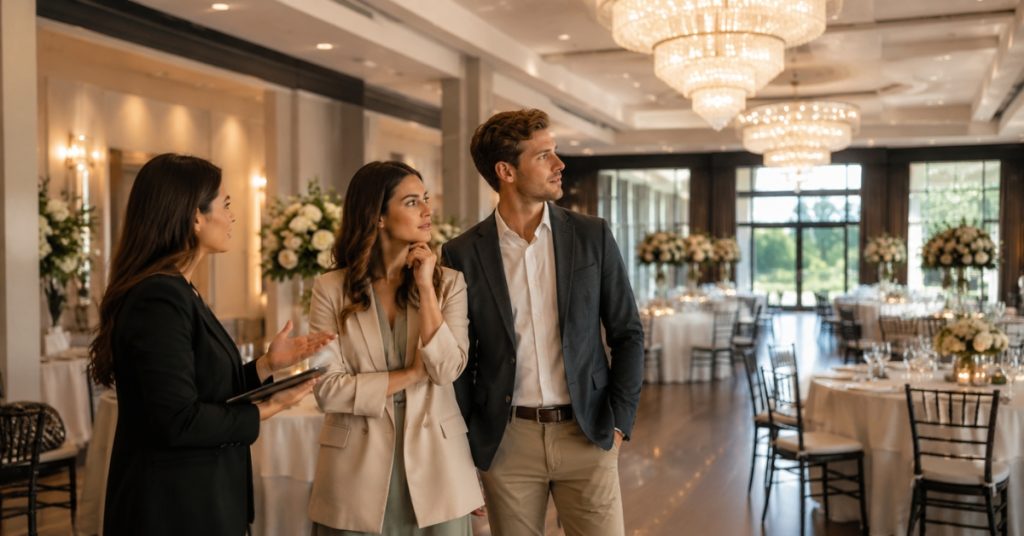
Before you shortlist a venue, ask questions like these:
- What AV is permanently installed, and what is brought in only on request?
- Is Wi-Fi included, and is it suitable for livestreams, presentations, or large guest usage?
- Is there a foyer, holding room, breakout area, or private pre-function space?
- Will a staff member be assigned during setup and the event itself? Landmark emphasizes dedicated event support through tailored corporate packages, which is worth confirming in detail.
- If the guest count changes, can the room be resized or reconfigured without hurting the experience? Landmark’s separate and combined ballrooms are a strong example of why this matters.
Treat catering and inclusivity as core criteria
Food is not a side issue in venue comparison. It is one of the clearest signals of whether a venue understands your audience. In Singapore, this is especially important for corporate functions, weddings, and family events where guest lists are often diverse. If halal compliance matters, verify it properly. MUIS is the authority that provides halal certification services and regulates Singapore’s halal industry, and MUIS also directs consumers to halal-certified establishments. That means planners should verify certification through official channels rather than relying only on a sales brochure or social media post.
This matters because catering affects more than menu preference. It affects who feels fully included at the event. Landmark is positioned as a halal event and dining venue in Bugis, which can be a major advantage for Muslim-friendly celebrations, multi-faith corporate gatherings, and family events where one catering decision needs to work for everyone. When comparing venues, ask not only “Is the food good?” but also “Will every guest feel comfortable eating here?”
Compare food flexibility, not just menu style
Venues vary widely in how food is handled. Some package venues and catering together. Others work from a panel of approved caterers. Jewel Changi, for example, lists a panel of renowned caterers for several spaces, while Landmark publishes event packages tied to seminar, buffet, and Chinese menu formats. Neither model is automatically better. A bundled model can simplify coordination. A caterer-panel model can give you more freedom if your event calls for a specific cuisine or concept. The key is to compare how much flexibility you actually have — and whether external vendor rules, corkage, plating style, or service timelines will affect the experience.
There is also a compliance angle many planners miss. If your event involves temporary food stalls in a private venue and there is handling of food for sale, SFA states that a permit is required, and individual stalls preparing food and beverages for sale will also require licensing through the fair operator. If your event includes liquor service, Singapore Police state that a liquor licence is required unless exempted. If you are planning entertainment, SPF also states that a Public Entertainment or Arts Entertainment licence is required unless exempted. In other words, unusual event formats need more than a pretty venue — they need a venue and organiser team that understand the regulatory side.
Compare the real cost, not just the headline rate
Headline pricing is rarely the final price. In Singapore’s hotel and F&B context, IRAS notes that businesses often add a service charge, typically at 10%, and GST is charged on the total price including service charge. That is why “from $30++” or “from $48++” is only the beginning of the budget conversation, not the end of it. Landmark’s packages, like many hospitality-led venues, are presented in this familiar “++” format and also specify minimum guest numbers for different menus and event types. A venue can look affordable at first glance and become less so once minimum headcount, service charge, tax, AV add-ons, parking, and timing extensions are factored in.
A better way to compare venues is to ask for the full commercial picture in writing. That includes what is included, what is optional, and what triggers extra charges. Hilton Singapore Orchard is a good benchmark for clarity because its delegate packages explicitly list venue rental, AV, Wi-Fi, flip charts, and parking. The clearer the inclusion list, the easier it is to compare value rather than just price.
When reviewing a quote, make sure it covers:
- Room rental or minimum spend structure.
- Minimum guest numbers and what happens if attendance drops below them. Landmark publishes minimum pax requirements across several packages.
- AV, staging, lighting, screens, and operator fees.
- Service charge and GST treatment.
- Parking, loading access, setup time, overtime, and breakdown timing.
- Whether catering is bundled, restricted to approved vendors, or open to external suppliers.
The venues that are easiest to work with are usually the ones that are easiest to understand on paper. Transparent pricing is not just a finance issue. It is often a sign of how the event itself will be managed.
Final thoughts
When you compare private event venues well, you are really comparing outcomes. Will guests arrive easily? Will the room suit the format? Will the sound, service, and food support the experience you want to create? Will the quote still make sense after the real costs are added? And will the venue help you host an event that is inclusive, compliant, and calm behind the scenes? The strongest venues tend to win on that full picture, not on one flashy feature. In Singapore, that usually means prioritising layout fit, accessibility, transport convenience, catering confidence, operational readiness, and transparent pricing from the start.
As guest expectations continue to rise, venue comparison is becoming less about square footage and more about experience design. Private event spaces that combine flexible layouts, strong guest access, reliable built-in infrastructure, and inclusive food and service standards will continue to stand out. For planners evaluating options in Singapore, that is the lens worth using.
FAQs
What is the first thing to compare when choosing a private event venue?
Start with event fit: the type of event, your expected layout, and your realistic guest count. A venue that works for a seminar may not work for a dinner, launch, or wedding, even if the room looks attractive online.
Why is location such a big factor in Singapore?
Because convenience affects attendance and punctuality. A centrally located venue near MRT access, such as the Bugis area, reduces friction for guests and usually makes corporate and social events easier to manage.
Should I compare venues by maximum capacity?
No. Compare them by the layout you actually need banquet, theatre, classroom, standing or reception. The same venue can support very different guest numbers depending on setup.
How do I verify whether a venue is truly halal-certified?
Use official MUIS resources rather than relying only on marketing copy. MUIS provides halal certification services in Singapore and points consumers to halal-certified establishments.
What extra cost details should I ask for before booking?
Ask for the full quote, including service charge, GST, minimum guest count, AV, parking, and what is included in the package. In Singapore’s hotel and F&B sector, service charge is often added and GST applies on the total including service charge.