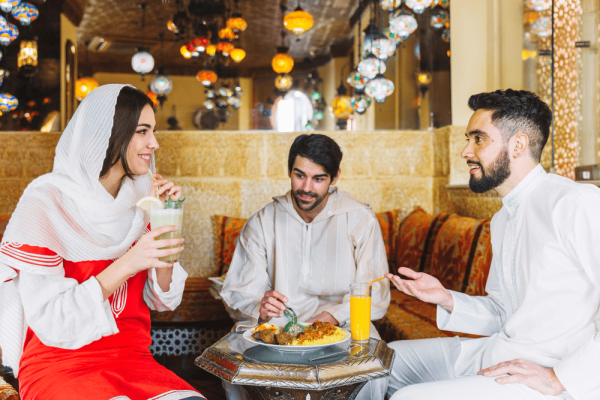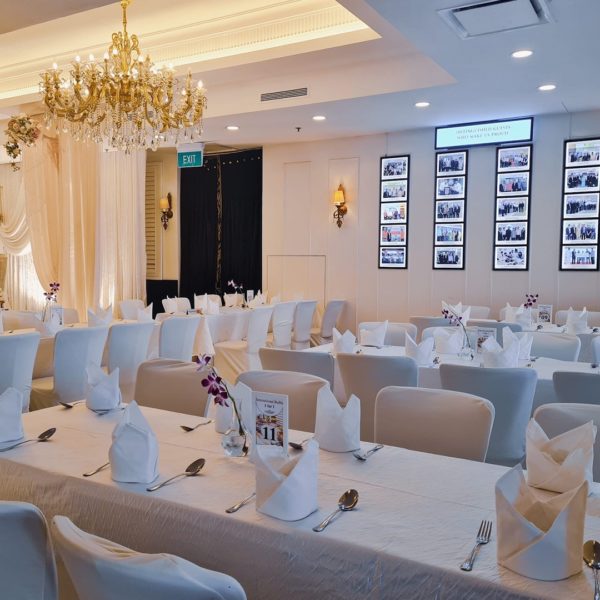
Finding a halal restaurant in Singapore is not hard. Finding one that also works smoothly for the whole family is where the real decision starts. A restaurant can look beautiful online and still fall short on the details that matter on the day itself: unclear halal status, a menu that only suits adults, cramped seating for strollers, long waits with hungry children, or a location that feels convenient until grandparents and cousins are all trying to get there from different parts of the island. In practice, the best family-friendly halal restaurant is the one that removes uncertainty before you even leave home. MUIS regulates halal certification in Singapore and provides a public directory of halal-certified establishments, while digital halal certificates introduced from October 1, 2025 let diners scan a QR code to check whether a certification is real and still valid.
That matters for both diners and businesses. For families, a better choice means less stress, fewer last-minute compromises, and a meal that actually feels like time together. For restaurants, making halal assurance and family comfort easy to understand is what helps turn a one-off visit into repeat bookings for birthdays, reunions, festive meals, and multigenerational celebrations. The Landmark in Bugis, for example, presents itself not just as a halal restaurant but as a venue for family gatherings, corporate dinners, weddings, and reunions, which is exactly how many Singapore families evaluate a dining venue in real life.
Put halal assurance first
When families are dining together, halal status should never be left to guesswork. In Singapore, MUIS is the body that provides halal certification services and regulates the halal industry, and its consumer pages direct the public to the official search tool for halal-certified eating establishments. That means your first filter should be verification, not vibes, branding, or a “Muslim-friendly” label on social media.
This is especially important because Singapore’s official Muslim visitor materials distinguish between MUIS-certified venues and other places that may describe themselves as halal or safe for Muslim diners. For a casual solo meal, some diners may be comfortable with that distinction. For a family gathering, though, verified certification is usually the simpler and safer standard because it removes debate inside the group.
A simple halal-check routine before you book
A quick pre-booking check can save a lot of awkwardness later:
- Search the restaurant in the MUIS halal establishments directory instead of relying only on third-party listings.
- If you are already at the venue, scan the QR code on its digital halal certificate to confirm the certification is current and authentic. MUIS says this feature allows the public to instantly check whether the certificate is real and still valid.
- If you are placing a deposit for a birthday or reunion, make sure the restaurant itself is presenting clear halal information on its own website or booking page, not just in a one-off advertisement.
Define family-friendly the way parents do
“Family-friendly” is one of those phrases that sounds helpful until you realize it can mean almost anything. For parents and multigenerational groups, it usually has less to do with trendy décor and more to do with whether the meal will be comfortable from arrival to dessert. In Singapore, family-oriented dining examples often highlight specific features such as high chairs, stroller-friendly space, kids’ counters, and activities that keep children occupied. Shangri-La Singapore promotes a dedicated kids counter and engaging activities for family dining, while local family dining coverage frequently treats high chairs and stroller-friendly layouts as baseline signals that a venue genuinely welcomes children.
That is why a good family restaurant should be judged like a real-life system, not a photo gallery. If the restaurant is halal-certified but the aisles are too tight, the tables are too close together, and children have nothing simple to eat, the outing becomes work. A better venue makes it easy for a toddler, a teenager, parents, and grandparents to share the same meal without anyone feeling like an afterthought.
Signs a restaurant is truly built for families
Look for practical clues, not just marketing language:
- Spacious seating or layouts that can handle groups, strollers, and the general movement that comes with children. The Landmark explicitly highlights spacious seating for groups and celebrations, and its family-gathering materials describe a layout suited to both small and large family events.
- Child-oriented dining touches such as high chairs, booster options, activity sheets, or a kids counter. These are recurring signals in Singapore’s family dining scene, from local parent guides to hotel dining programs.
- A service style that reduces waiting. Buffets often help here because children do not have to wait through multiple rounds of ordering before food arrives. The Landmark’s own buffet positioning emphasizes immediate access to food as a convenience for families with young children.
- Transparent child pricing. Families plan by headcount, so it helps when a restaurant clearly states child rates instead of leaving parents to ask at the door.
Choose a menu that works across generations
One of the biggest mistakes people make is choosing a restaurant based on what one person wants to eat. Family dining rarely works that way. Children often want familiar flavors, grandparents may prefer milder or more traditional dishes, and adults usually want enough variety to feel the outing is worth the effort. The most practical halal restaurants in Singapore are the ones that reduce this tension by offering range without making the menu confusing.
This is where broad buffet formats often do well. The Landmark’s menu positions itself around international, local, western, seafood, and Indian cuisines, while its broader buffet messaging highlights local and international favorites, selected live cooking stations, and kids-friendly selections. That kind of spread is helpful for mixed-age groups because nobody has to “win” the menu discussion before the meal begins.
There is also a pacing advantage. In large family groups, à la carte dining can create staggered service, repeated ordering, and separate rounds of waiting. A buffet can simplify that because people can start with what suits them and return when they are ready. The Landmark explicitly frames this as a benefit for large groups and families with young children, and that logic is easy to understand if you have ever tried to keep a table of children patient while adults debate mains.
What to check on the menu page before you decide
A menu page should answer practical questions quickly:
- Is there enough variety for both adventurous eaters and picky eaters?
- Are there clear child prices or family-friendly meal terms? The Landmark lists children aged four to eight at a specific buffet rate, with children below four dining free, while Shangri-La Singapore also publishes child dining terms for family buffet access.
- Does the restaurant present the meal as suitable for celebrations and group dining, not only casual walk-ins?
Prioritize convenience, not just cuisine
A family meal starts before the first plate. In Singapore, accessibility can be the difference between a relaxed gathering and a tiring one. Central locations, straightforward transport links, and predictable opening hours matter because they reduce friction for every age group. That is especially true for family reunions, Ramadan meetups, birthdays, and weekend lunches where relatives may be arriving from several neighborhoods.
The Bugis area is a strong example of why location matters. Village Hotel Bugis is officially listed at 390 Victoria Street and is described by Far East Hospitality as being a short walk from Bugis MRT, with nearby access to Kampong Glam and surrounding heritage districts. Landmark is located within Village Hotel Bugis and lists the same address, which makes it easier to judge transport convenience before booking.
Convenience also includes timing transparency. A restaurant that clearly states lunch and dinner windows helps families plan around naps, prayer routines, school schedules, and senior-friendly timings. The Landmark publishes daily lunch and dinner service hours on its website and promotions pages, which is exactly the kind of detail families appreciate when they are coordinating multiple age groups.
Use a real venue as a benchmark
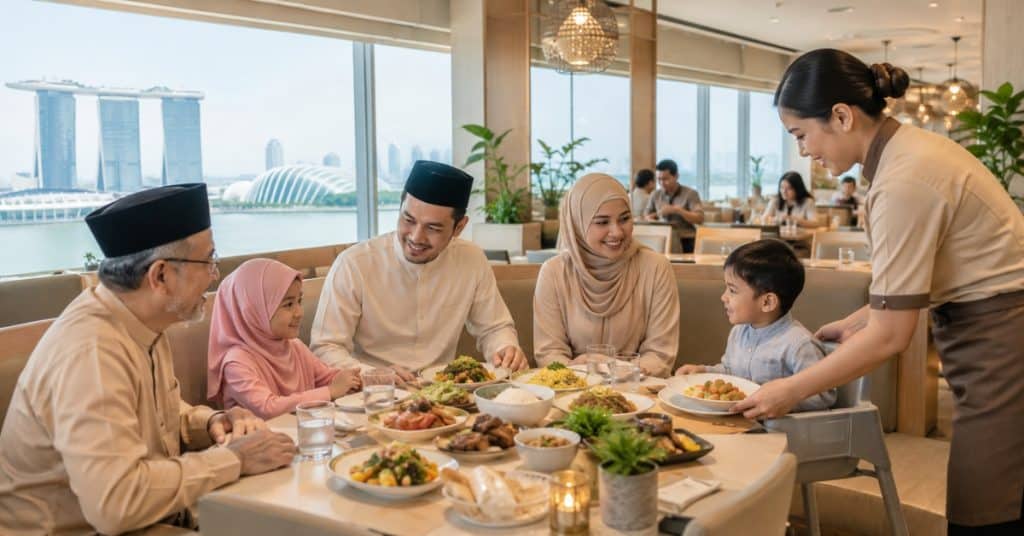
A useful way to shortlist restaurants is to ask whether a venue meets the standards you would want any family-friendly halal restaurant in Singapore to meet. By that framework, The Landmark in Bugis is a practical benchmark because it publicly identifies itself as MUIS halal certified on its promotions page, is positioned for family gatherings and celebrations, offers spacious seating, and sits in a central Bugis location inside Village Hotel Bugis.
It also handles menu breadth in a way that suits mixed groups. Its site describes international and local favorites alongside western, Mediterranean, seafood, and Indian options, selected live cooking stations, and group-friendly seating. On the budget side, it clearly states child pricing for ages four to eight and free dining for children below four, which helps parents estimate the total spend before they commit.
That does not mean it is the only good choice in Singapore. It means it checks the boxes that matter most: halal clarity, family usability, menu flexibility, and transport convenience. If you are evaluating other restaurants, those are the same boxes they should be able to check just as clearly.
Conclusion
Choosing a family-friendly halal restaurant in Singapore is really about choosing certainty. Halal assurance comes first, because it sets the foundation for trust. After that, the best venues are the ones that make family dining feel easy: enough space, enough variety, sensible child options, and a location that does not turn the outing into a travel puzzle. Restaurants that are transparent about these details help families decide faster and dine more confidently.
Looking ahead, the standard for halal family dining in Singapore is becoming easier to verify, not harder. MUIS’s digital halal certificates and QR-based checks are pushing restaurants toward clearer proof and better transparency. That is good for diners, and it is good for restaurants that genuinely want to become the default choice for birthdays, reunions, and Sunday meals. If a venue can prove its halal status and show that it understands how families actually dine, it will always stand out.
FAQs
How can I verify that a restaurant is halal-certified in Singapore?
Use the MUIS halal establishments search tool, and if you are at the venue, scan the QR code on the digital halal certificate to confirm it is genuine and still valid.
What makes a halal restaurant family-friendly?
Look for practical features such as spacious seating, high chairs, stroller-friendly layouts, kids-focused food options, and a service style that does not keep children waiting too long.
Is a buffet a good choice for family dining?
Often, yes. A buffet gives children and adults faster access to food and makes it easier to satisfy different tastes and dietary preferences within the same group.
Why does location matter so much for family meals in Singapore?
Because a central, easy-to-reach venue reduces friction for grandparents, parents, and children arriving from different areas. Restaurants near MRT stations are usually easier to coordinate for larger gatherings.
Why is The Landmark a strong option for families?
It presents itself as MUIS halal certified, offers a broad buffet selection, publishes child pricing clearly, and is located at Village Hotel Bugis within a short walk of Bugis MRT.