Choosing a ballroom in Singapore sounds simple until you realize how many moving parts sit behind that decision. A room that looks elegant online can still be wrong for your guest count, awkward for your program flow, inconvenient for older guests, or too limited for the kind of dining, AV, and cultural requirements your event actually needs. That matters because Singapore’s venue market spans everything from compact function rooms to very large hotel ballrooms, so the “best” venue is rarely the biggest or the fanciest. It is the one that fits your event format, your guests, and your operational needs without creating friction. Official venue listings show just how wide that range can be: The Landmark’s Sapphire is sized for smaller events, while larger Singapore properties advertise capacities from 360 to 1,350 guests depending on format and space configuration.
Start with the event brief, not the venue photos
The smartest way to choose a ballroom is to define the event before you shortlist the venue. Is this a wedding, seminar, product launch, appreciation dinner, family celebration, or corporate town hall? Each format has different needs for seating, staging, sound, lighting, foyer use, meal service, and guest movement. Even on Landmark’s own venue page, the same room is listed with different capacities for standing cocktail, seating, and theatre style, which tells you immediately that the layout is not a small detail; it changes what the room can realistically handle.
Lock in your real guest count
Do not book based on your “wishlist” attendance. Book based on realistic confirmations, plus a small buffer. A ballroom that is too small will feel cramped at registration, buffet lines, and family photo moments. A ballroom that is far too large can make the event feel under-attended and dilute the atmosphere. At The Landmark, Sapphire is listed at 120 standing, 100 seating, and 80 theatre-style; Red Velvet at 180 standing, 150 seating, and 120 theatre-style; and The Landmark Ballroom at 280 standing, 250 seating, and 200 theatre-style. Those numbers are useful because they show how quickly capacity shifts once you move from standing reception to seated or presentation-focused formats.
Match the room to the way the event will unfold
A seminar, for example, needs sightlines, screen visibility, and enough room for note-taking or classroom-style seating. A wedding or gala dinner needs smooth service flow, stage visibility, family circulation, and photo-friendly spacing. A networking event may need less seating but more standing room and better breakout flow. Landmark’s seminar package explicitly supports cluster, theatre, and classroom layouts, which is a helpful reminder that room selection should be tied to the way your agenda runs, not just to how the ballroom looks in a brochure.
Before you start site visits, get these basics on one page:
- Expected attendance range and your likely final turnout, not the optimistic number. Landmark’s room listings make clear that 80, 120, 150, 200, and 250 guests can land you in very different venue categories.
- Event format such as banquet, theatre, classroom, cocktail, or mixed-use. Landmark’s current seminar package lists cluster, theatre, and classroom arrangements, which is exactly the sort of operational detail you want clarified early.
- Program requirements including stage use, presentations, emcee segments, live entertainment, prayer breaks, buffet circulation, VIP holding areas, or breakout sessions. Different venue types in Singapore advertise very different strengths here, from adjacent foyers to multiple function rooms and built-in AV support.
Choose room size and layout flexibility over headline prestige
One of the easiest mistakes in venue selection is assuming that a more prestigious property automatically gives you a better event. In practice, fit matters more than brand. Singapore’s larger hotels frequently showcase their scale and flexibility because clients value it: The Westin Singapore’s Grand Ballroom can be divided into two smaller spaces and has an adjacent foyer for pre-event receptions; voco Orchard Singapore’s Grand Ballroom can be configured into three separate spaces; and Holiday Inn Singapore Orchard City Centre’s Crystal Ballroom is also divisible into three suites. That kind of flexibility matters because it lets you right-size the room to the event instead of forcing the event to adapt to the room.
Why the pre-function area matters more than most planners expect
Guests judge an event before they enter the main ballroom. If the registration area is cramped, if there is no natural holding space for late arrivals, or if the foyer cannot support sponsor booths, photo backdrops, or coffee stations, the event feels disorganized even when the ballroom itself is beautiful. That is why venues often highlight foyers and connected breakout areas. The Westin specifically notes an adjacent foyer for pre-event receptions, and voco Orchard highlights reception-friendly foyers for some of its function spaces.
Bigger is only better when your guest flow needs it
Singapore venues demonstrate this well. Grand Hyatt Singapore advertises spaces for much larger programs, while St. Regis Singapore lists 10 event rooms and a largest capacity of 450. Those numbers are useful not because you need the biggest room, but because they show how broad the market is. If you are hosting 90 guests, a venue designed primarily for much larger events may not give you the intimacy or value you need. If you are hosting 400 guests, a smaller ballroom with excellent décor will still create service bottlenecks.
Make location and arrival effortless for your guests
In Singapore, convenience is not a nice-to-have. It directly affects punctuality, turnout, and guest satisfaction. A centrally located venue reduces the friction of travel for corporate attendees coming from different business districts, as well as for wedding and family guests arriving from all over the island. The Landmark is located at Village Hotel Bugis on Victoria Street, and its contact page gives practical transport guidance: it is a five-minute walk from Bugis MRT Station via Exit B, with bus options, taxi drop-off guidance, and parking available at B1 and Level 4. That level of access planning matters because guests remember whether the event felt easy to attend.
Accessibility should be part of the same conversation. Singapore’s Building and Construction Authority states that the Code on Accessibility in the Built Environment provides baseline requirements to ensure buildings are accessible for persons with disabilities, the elderly, and families with young children. In practical terms, that means you should still inspect the real guest journey: the drop-off point, lift access, accessible route to the ballroom, restroom proximity, and whether older family members or delegates with mobility needs can move around comfortably without asking for help at every turn.
A simple example: a ballroom may be perfect on paper for a wedding dinner, but if grandparents have to navigate multiple level changes or guests struggle to find parking and the correct lift lobby, the venue is no longer doing its job. That is why centrality, on-site parking, and a clear pedestrian route often matter more than one extra design flourish.
Test the ballroom’s built-in support before you compare prices
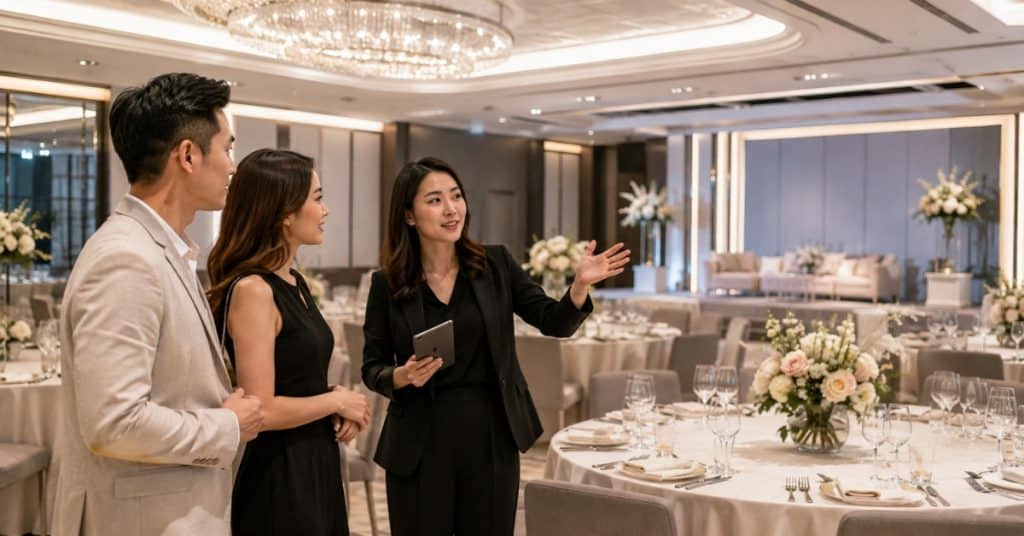
A ballroom quote is only meaningful when you know what is included. Two venues can look similar on price but differ sharply in operational value once you account for projectors, microphones, Wi-Fi, screens, staging, signage areas, parking support, room setup time, and whether the venue team can handle layout changes smoothly. The seminar package currently linked from Landmark’s venue page is a good example of why this matters: it includes venue usage, multiple seating arrangements, flipchart, whiteboard, notepads, rostrum, Wi-Fi, projectors, screens, two cordless microphones, a basic AV sound system, ice water and mints, and car park coupons based on 10% of guaranteed attendees.
That is especially important for business events. If the venue already supports your seminar or presentation format, you avoid the headache of bringing in external AV vendors for a basic setup. And if your event is more brand-led or production-heavy, you may want to shortlist venues that publicly highlight stronger visual infrastructure. Grand Hyatt Singapore’s Grand Ballroom advertises extended digital video projection, while PARKROYAL COLLECTION Pickering promotes a 16-metre LED ballroom wall, dual 6-metre LED screens, and versatile setups.
Food support belongs in this same evaluation, not in a separate afterthought column. A ballroom may be impressive, but if the menu quality, service style, or dietary flexibility is poor, the overall event suffers. The Westin Singapore, for instance, emphasizes customized menus and themed coffee breaks, which reflects a broader truth: catering flexibility is part of venue quality, not just an add-on.
When you do a site visit, ask to see or confirm:
- What is built in and what is extra-charge: screens, projectors, microphones, sound system, Wi-Fi, lectern, staging, and parking support. Landmark’s currently linked seminar package is a useful benchmark because it spells these items out clearly.
- How flexible the room is during the event: can it be split, reconfigured, or supported by an adjacent foyer or breakout room? Venues such as The Westin, voco Orchard, and Holiday Inn Orchard City Centre all highlight this kind of adaptability.
- Whether the ballroom suits your production level: some spaces are ideal for simple speeches and networking, while others are built for more dramatic visual presentations. Singapore venues increasingly advertise digital projection, LED walls, and advanced lighting because these features materially change the guest experience.
Match the venue to your guests’ expectations and cultural needs
This is the part many planners underestimate until late in the process. A ballroom is not just a box with tables. It has to work for the people you are inviting. In Singapore, that often means paying close attention to food requirements, prayer needs, family dynamics, and cultural expectations around seating or service style. The Islamic Religious Council of Singapore states that MUIS provides halal certification services and regulates the Singapore halal industry, which is why clear certification matters when Muslim guests are part of the event.
For venues where halal assurance is essential, clarity on certification can shorten the decision process and reduce guest uncertainty. The Landmark publicly labels itself as MUIS Halal Certified on its promotions page, and its broader site consistently presents the venue as a halal dining and events destination.
The same principle applies to event setup. Landmark’s own event guidance for Muslim-friendly celebrations recommends checking for prayer space, parking, AV support, customizable décor, menu flexibility, and where necessary, segregated seating options. That is a practical checklist not only for religious events, but for any event where guest comfort depends on the venue understanding more than just table counts.
In real-world terms, this means a family wedding in Singapore may need different things from a corporate awards night even if the guest count is identical. One may prioritize prayer access, halal assurance, buffet flow, and multigenerational comfort. The other may care more about presentation technology, reception space, and breakout rooms. The right ballroom is the one that respects those priorities without forcing you to build too many workarounds.
Compare proposals like an operator, not just a host
Once you narrow your shortlist, do not compare venues by package headline alone. Compare them by the amount of problem-solving they remove from your planning process. A well-priced ballroom is not automatically a good-value ballroom if it needs external AV, extra décor work, additional crowd management, or complicated guest directions. On the other hand, a venue that includes core meeting tools, flexible layouts, strong transport access, parking support, and a menu style that already fits your audience may save you both money and stress. Landmark’s published package inclusions illustrate this well because they combine room usage, AV basics, stationery, seating configurations, and parking support into one operating framework rather than leaving every item to be sourced separately.
It also helps to think in scenarios. For a focused seminar or workshop of around 80 to 120 attendees, a room like Sapphire or Red Velvet may be more efficient than booking a much larger ballroom and then trying to “fill the gap.” For a mid-sized banquet or corporate dinner, The Landmark Ballroom’s higher seated capacity may create a better balance of atmosphere and functionality. And for large-scale conventions or major galas, properties that advertise several hundred to over a thousand guests may be more appropriate. The point is not to chase scale. It is to buy the right amount of venue.
Conclusion
The right ballroom in Singapore is not the one with the most dramatic chandelier or the most recognizable hotel name. It is the one that fits your event brief, supports your guest journey, makes your program run smoothly, and reflects what your audience actually needs. Start with attendance, format, and guest expectations. Then test location, accessibility, built-in AV, catering flexibility, and cultural fit. If a venue can deliver the right room size, easy arrival, operational support, and clear inclusions, you are not just booking a ballroom. You are reducing risk and increasing the chances that the event feels effortless from the first guest arrival to the last goodbye. Venues like The Landmark are useful examples of this approach because they pair multiple room sizes with central Bugis access, published capacity information, MUIS Halal Certified positioning, and practical event support rather than relying on aesthetics alone.
FAQs
What is the first thing to check before booking a ballroom in Singapore?
Start with your actual guest count and event format. Ballroom capacity changes depending on whether the setup is standing, banquet, classroom, or theatre style.
Why does ballroom location matter so much in Singapore?
Because easy access improves turnout and punctuality. A venue near MRT, bus routes, and on-site parking removes friction for guests. The Landmark, for example, is a five-minute walk from Bugis MRT and offers parking on-site.
Should I choose a bigger ballroom just to be safe?
Usually no. An oversized ballroom can make an event feel flat, while an undersized one creates crowding. The best choice is a room that fits your realistic attendance and layout.
What venue features save the most planning effort?
Built-in AV, Wi-Fi, flexible seating layouts, foyer space, catering support, and parking assistance can save significant coordination time. Landmark’s currently linked seminar package is a good example of how those inclusions add value.
How do I know if a ballroom is suitable for Muslim guests?
Look for clear halal certification and ask about prayer space, menu flexibility, and seating preferences if needed. MUIS manages halal certification in Singapore, and The Landmark publicly states that it is MUIS Halal Certified.