A wedding solemnisation in Singapore is not just a symbolic moment. For a civil marriage, it is the legal ceremony performed by a licensed solemniser in the presence of two credible witnesses, and it can only take place after the Registry of Marriages has issued the marriage licence. That is why a solemnisation that looks simple on social media can become stressful in real life if the date, venue, witnesses, or paperwork are not settled early enough.
What makes a solemnisation memorable is rarely extravagance alone. It is the feeling that the day moved naturally, the venue suited the guest list, the ceremony felt personal, and no one was distracted by avoidable problems such as rain, cramped seating, unclear timing, or dietary concerns. In Singapore especially, where weather can turn quickly and guest expectations often span different cultural and family norms, the best planning is equal parts legal, logistical, and emotional.
Know the legal path before you book anything
Civil marriages
For a civil marriage, the first planning rule is simple: do not pick a dream date and assume the legal side will catch up later. Couples must submit their marriage application at least 21 days before the intended solemnisation date, and no earlier than 6 months before it. Once submitted, the application is valid for 6 months.
If you want the solemnisation at an external venue rather than at ROM, confirm the venue, date, and time first. Then invite a licensed solemniser through the portal when you submit the marriage application. ROM itself handles in-house solemnisers only for ceremonies held at ROM.
A few practical rules matter more than couples often realise:
- Two witnesses are required, they must be above 21 years old, and they must be physically present on the day with their original NRIC or passport.
- If both parties are foreigners, ROM checks that at least one of them stayed in Singapore for at least 31 continuous days before submitting the application.
- If both parties are Singapore Citizens or Permanent Residents, that 31-day stay requirement does not apply.
- A civil solemnisation is the legal act. Any customary or religious ceremony around it may be meaningful to the family, but for a civil marriage it does not replace the legal solemnisation.
Muslim marriages
If you are planning a Muslim marriage, follow the Muslim marriage process rather than the civil ROM route. The official process is handled through the Our Marriage Journey Muslim marriage path, and key ceremony roles and documents differ from a civil solemnisation. Official guidance states that Muslim solemnisation requires two witnesses, and where applicable the bride’s wali is part of the process; required documents for solemnisation include IDs for the groom, bride, wali if applicable, and two witnesses, together with mahar and hantaran information. Couples also book a Kadi or Naib Kadi through the official system.
That difference matters for venue planning. A couple planning an akad nikah-style solemnisation needs more than a pretty stage. They need a venue that can support the actual ceremony flow, family positioning, document handling, and the comfort of guests who may expect a more traditional setup.
Choose a venue that supports the ceremony, not just the photos
A common mistake is choosing a venue based on aesthetics before asking whether it suits the kind of solemnisation you actually want. ROM is efficient for couples who want a straightforward legal ceremony, but it has limits: ROM solemnisation is available on weekdays except public holidays, and the solemnisation room accommodates up to 20 people including the couple. That works for a compact legal appointment, but it is not ideal if you want a fuller family moment or a ceremony that flows into lunch, dinner, or a cultural celebration.
By contrast, an external solemnisation venue gives you much more freedom. Official guidance notes that solemnisation outside ROM lets couples determine the venue, date, time, and theme of the wedding, which is why so many couples prefer it when they want the legal ceremony and the social celebration to feel like one coherent event.
When you compare solemnisation venues in Singapore, look at the details that change the experience for everyone in the room:
- Guest fit: Make sure the room size matches the actual attendance. A solemnisation feels awkward when a 40-person event is dropped into a ballroom that feels empty, or when 80 guests are packed into a setup designed for half that number. Venue planning guides from Landmark explicitly stress confirming guest capacity early.
- Weather backup: Singapore regularly gets short-duration thundery showers on many afternoons, often extending into the evening. If you want a garden-style entrance or outdoor photos, make sure the venue has a reliable indoor fallback.
- Accessibility: Ask about parking, elevators, drop-off convenience, and access for elderly or differently abled guests. These are not “nice to have” details; they shape whether the day feels smooth or tiring.
- Food and faith needs: If halal catering matters to your families, verify the venue properly. MUIS is the official body that provides halal certification services in Singapore and maintains a list of halal-certified eating establishments.
- On-site support: AV equipment, microphones, projector screens, prayer areas, reception tables, and staff support all reduce the number of outside vendors you need to coordinate.
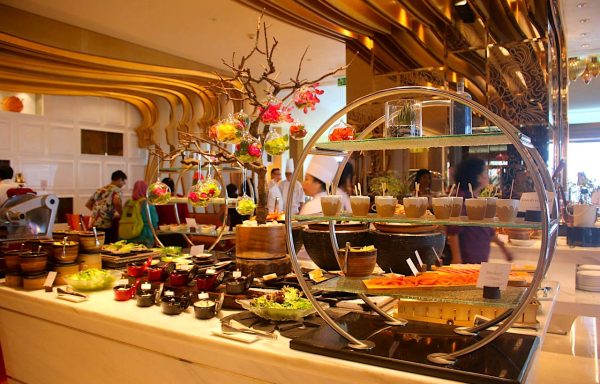
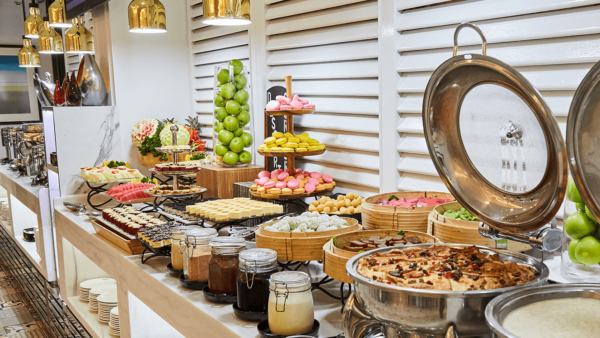
For couples who want one venue to handle both the legal ceremony and the hospitality side well, The Landmark is a relevant example. Its wedding page says it hosts Malay, Indian, Middle Eastern, and multicultural weddings, and its solemnisation offering starts from $5,346 nett for 50 guests. Landmark also states that it is MUIS halal certified and located at Village Hotel Bugis, which makes it a practical option for couples who want a halal-friendly, centrally located solemnisation venue in Singapore.
Shape a ceremony flow that guests will actually remember
Keep the legal moment simple and build warmth around it
Many solemnisations feel flat not because the couple chose the wrong venue, but because they planned only the signing and forgot the surrounding experience. Official guidance says a ceremony at ROM usually takes about 8 to 10 minutes. External solemnisation ceremonies may take longer because the solemniser can conduct them in a manner he or she deems fit, and couples are encouraged to communicate their plans directly with the solemniser.
That creates an opportunity. Instead of treating solemnisation like a quick administrative stop before “the real wedding,” design the event around it. A good flow often looks like this in practice: guests arrive with time to settle, the solemnisation begins on time, the signing and congratulations happen without chaos, family photos happen immediately while emotions are still high, and the meal or reception starts without a long awkward gap. This structure is especially effective in Singapore because guests often arrive from different parts of the island, and long idle periods quickly sap energy from the room.
Make the ceremony feel personal without making it messy
A memorable solemnisation does not need too many moving parts. It needs a few meaningful ones. Think about the parts families actually remember: the walk-in, the words exchanged, the witness moment, the first congratulations, and the transition into the celebration. If you are planning a civil solemnisation with cultural elements added around it, be clear which moments are legal, which are ceremonial, and when guests should pay attention. That clarity helps mixed-age and multicultural guest groups feel included instead of confused.
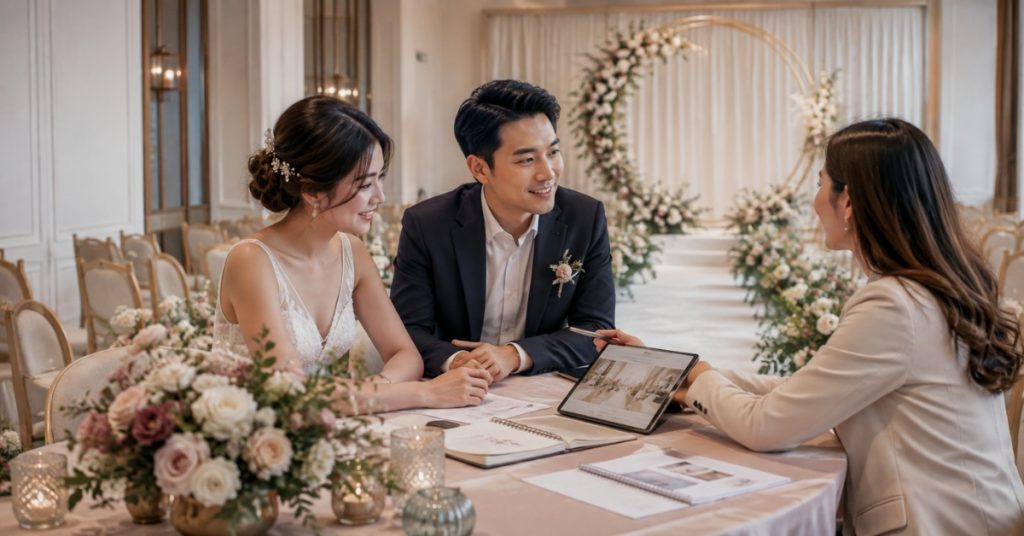
If your solemnisation is held outside ROM, this is where venue design matters. Inclusive packages that already cover seating layout, sound, reception styling, and meal service make it much easier to keep the emotional tone intact. Landmark’s solemnisation package, for instance, includes venue use, décor elements, basic sound support, drinks, parking coupons, and a prayer area, which shows how an all-in-one setup can remove friction on the day itself.
Plan for Singapore-specific comfort and culture
Singapore weddings often bring together different generations, different expectations, and sometimes different languages in one room. That means guest comfort is not a side issue. It is part of the ceremony design.
Start with timing. Hot afternoons, humidity, and the possibility of thundery showers all affect how long guests are comfortable sitting outdoors, walking between spaces, or waiting for photos to finish. Even if you love natural-light portraits, keep them short and give your guests an indoor plan, drinks, and clear directions. That kind of planning feels invisible when done well, which is exactly the point.
Then think about family practicality. Older relatives usually appreciate easy drop-off, clear seating, a ceremony that starts on time, and a meal that follows soon after. Muslim families may also appreciate a venue with prayer facilities and verified halal food rather than vague Muslim-friendly claims. Landmark’s own wedding and venue content repeatedly positions these issues halal certification, prayer space, capacity, and setup flexibility as decision points couples should check before booking.
There is also a communication side to memorable solemnisations. If you are blending a legal civil ceremony with family customs, tell guests what to expect on the invite or through the emcee. If your event is intimate, say so. If lunch begins right after signing, signal it. If witnesses have a special role, brief them in advance. Good communication makes a solemnisation feel gracious and calm instead of improvised. Official guidance even stresses practical details like witness readiness and arriving early, which shows how much the experience depends on small operational decisions.
Spend wisely without losing atmosphere
A solemnisation can feel elegant without becoming financially bloated. The trick is to separate legal costs from experience costs. Officially, there is no difference in marriage application fees whether you solemnise at ROM or at an external venue. So when external solemnisation becomes more expensive, the extra cost usually comes from the venue experience itself: food, décor, photography, upgraded AV, florals, timing extensions, or guest logistics.
That is why package transparency matters. Inclusive venue packages can be better value than a seemingly cheaper venue that requires separate rentals for basic items such as microphones, reception tables, chair décor, parking support, or prayer space. Landmark’s solemnisation package is a good example of how bundled value works: the package lists venue usage, décor, buffet, drinks, projector screens, parking coupons, and a prayer area under a single solemnisation offering.
Before you commit, ask for a final quotation that clearly states the following:
- what is included in the base package and what carries extra charges, especially décor upgrades, extra hours, or live stations;
- whether you will be charged if you later change the venue, date, time, witnesses, or solemniser after filing your civil marriage application, since ROM states that changes to solemnisation details carry a $25 fee;
- whether the venue team coordinates the solemniser setup, witness table, and ceremony seating, or whether you must appoint a third party to manage the flow.
One more budgeting note: licensed civil solemnisers are volunteers. No fee is expected, although couples may choose to reimburse costs or give a token of appreciation. That means your budget should focus less on “paying the solemniser” and more on the things that guests actually experience comfort, timing, food, and flow.
A memorable solemnisation is usually a well-edited one
The best wedding solemnisations in Singapore are not necessarily the biggest. They are the ones that respect the legal process, fit the guest list, and feel thoughtfully local. That means understanding ROM or ROMM requirements early, choosing a venue that works in Singapore’s climate and family reality, and building a ceremony flow that feels warm without becoming chaotic.
If there is a future-facing lesson here, it is this: couples are increasingly rewarded when they treat solemnisation as the heart of the day rather than the paperwork before it. In a city where time, space, and convenience matter, the most memorable celebrations are often the ones that keep the legal core clear, place guests at ease, and bring ceremony and hospitality together in one seamless setting.
FAQs
How early should I plan my solemnisation in Singapore?
For a civil marriage, submit the marriage application at least 21 days before the solemnisation date and no earlier than 6 months before it.
Do I need a licensed solemniser if I choose an external venue?
Yes. If your civil solemnisation is outside ROM, you must invite a licensed solemniser. If you solemnise at ROM, ROM arranges an in-house solemniser.
How many witnesses do I need?
For a civil solemnisation, you need two witnesses. They must be above 21 years old and physically present on the day with their original NRIC or passport.
Is an external solemnisation more expensive legally than ROM?
Not in terms of the marriage application fee. ROM states there is no difference in marriage application fees whether the solemnisation is held at ROM or at an external venue.
What makes a solemnisation venue truly practical in Singapore?
Look for the right guest capacity, a wet-weather backup, easy accessibility, clear package inclusions, and verified food arrangements such as MUIS halal certification when needed. Those factors usually matter more than décor alone.