Office catering looks simple until one mistake turns lunch into an awkward moment. With halal catering, the stakes are higher because you are not only feeding a team. You are making sure Muslim colleagues can eat with confidence, guests feel respected, and the event runs smoothly from delivery to clean-up. In Singapore, that means organisers should think about two separate checks at the same time: halal verification through MUIS and food-business safety through SFA. If either one is overlooked, the event can feel careless even when the food itself looks impressive.
The good news is that halal office catering becomes much easier once you stop treating it as “just order food” and start treating it like an event workflow: verify the vendor, choose the right service format, build a menu that suits a mixed team, and manage timing carefully on the day. That approach is especially useful in Singapore, where buffet service, packed meals, corporate seminar catering, and venue-based halal events are all widely available. Providers such as The Landmark, for example, combine halal dining with corporate-event packages, which is one reason venue-and-catering bundles appeal to organisers who want fewer moving parts.
Why halal catering needs a proper planning framework
A lot of organisers think halal catering starts and ends with avoiding certain ingredients. In practice, Singapore’s halal system is much more structured than that. MUIS is the authority that provides halal certification services and regulates the Singapore halal industry, and MUIS also directs consumers to its public listing of halal-certified eating establishments and food preparation areas. That matters because verbal reassurance is not the same thing as formal certification.
Food safety is a separate layer. SFA states that food businesses generally must be licensed to prepare and sell food, and that higher-risk, larger-scale operations such as catering businesses are required to be licensed so SFA can impose food safety controls upstream. For corporate organisers, this means “halal” and “properly approved for catering” are two different boxes that both need to be ticked.
That is why the smartest way to organise halal catering is to use a three-part filter before you discuss dishes or budget: religious compliance, food-safety legitimacy, and event-fit. Once those are clear, the rest of the planning becomes much more straightforward.
Verify the caterer before you compare menus
Check MUIS status first
For an office event in Singapore, the cleanest starting point is to confirm that the caterer or food preparation area is listed in the MUIS halal establishments directory. MUIS’ own public guidance points consumers to that listing, so this should be your first verification step, not something you do after the quotation is approved.
It is also worth understanding what certification represents behind the scenes. Under MUIS’ Food Preparation Area Scheme, ingredients and food products must be substantiated before purchase, halal and non-halal items must be physically segregated during transportation, and the establishment must maintain a halal team with defined roles and competency requirements. For organisers, that is the real value of certification: it reflects a controlled system, not just a menu claim.
Check SFA approval and operating track record
After halal verification, confirm that the business is actually approved to conduct catering. SFA states that catered food should be obtained only from food businesses approved to conduct catering activities, including SFA-licensed food caterers and select central kitchens. SFA also makes clear that only SFA-licensed food businesses can offer food catering, while home-based food businesses are not allowed to provide buffet lines or packed meals as catering.
This is where a quick due-diligence check can save trouble. SFA’s public track-record tool allows users to check licensed food establishments, including caterers, by viewing their SAFE grades and track records. If you are organising a formal client lunch, board meeting, or staff celebration, this is a practical step that many buyers skip.
A short pre-booking checklist
Before you approve any halal catering quote, make sure you can answer these questions clearly:
- Can the caterer be verified through the MUIS halal establishments listing for halal-certified eating establishments or food preparation areas?
- Is the food coming from an SFA-approved catering business, such as an SFA-licensed food caterer or approved central kitchen?
- Does the caterer have a visible SFA track record or SAFE grade that you are comfortable with checking?
- Is the vendor a proper catering operator rather than a home-based seller, since home-based businesses are not allowed to offer buffet lines or packed meals as catering?
Match the service format to the way your office actually eats
The biggest practical mistake in office catering is choosing a format that looks good on paper but does not fit the event flow. A buffet is not automatically the best option. Sometimes the right answer is a buffet. Sometimes it is packet meals. Sometimes it is a venue with catering built in.
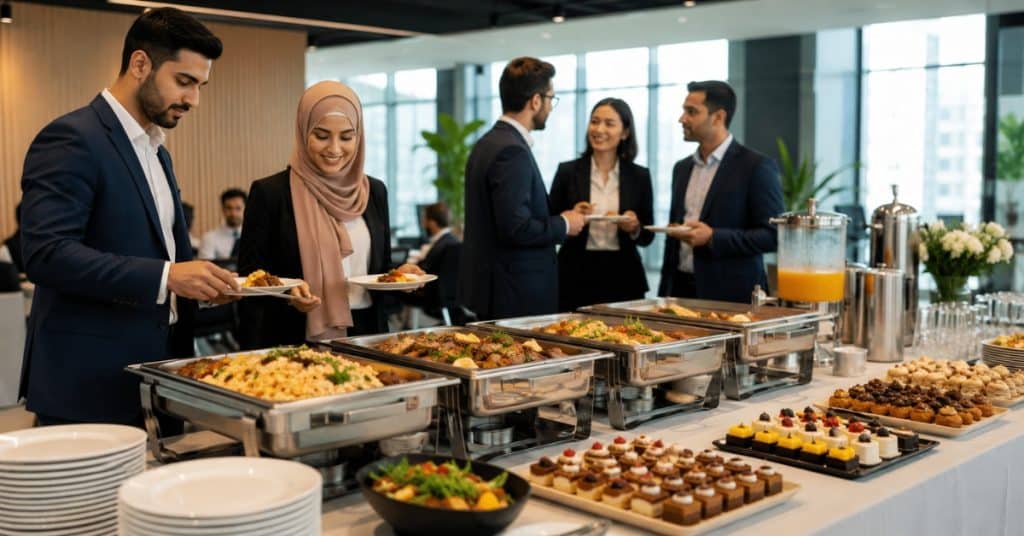
Choose buffet service when everyone can eat in one window
A buffet works best when most guests will eat at roughly the same time and in the same place. It is useful for team lunches, appreciation events, festive gatherings, and internal celebrations where the meal is part of the social experience. This format also suits spreads with more choice, which is one reason halal buffets are popular for mixed groups. The Landmark, for example, positions its halal buffet offering around variety and inclusivity, and also highlights Western, Indian, and Malay options under its halal buffet experience.
If you want the event itself to feel more polished, venue-based corporate catering can simplify things further. The Landmark’s corporate-events page, for instance, highlights audiovisual systems, three ballrooms, capacity for up to 80 people, access near the CBD, parking, and public transport convenience. That kind of bundled setup works well when the office event is part meeting, part catered function.
Choose packet meals when timing is staggered
Packet meals are often the stronger option for training days, multi-floor offices, staggered lunch breaks, or events where guests need to grab food and return to work quickly. SFA’s guidance is especially clear here: packet meals must carry time-stamp labels, should be collected and consumed as soon as possible, and if meal times are staggered, organisers should arrange staggered delivery times rather than a single drop for everyone.
A simple rule of thumb is this: if your event involves people moving between rooms, sessions, or floors, packet meals usually create less friction than a buffet. If your event is built around shared time together, a buffet tends to create a better atmosphere. That is not a law of catering, but it is a useful operational rule drawn from how SFA advises catered food to be handled.
Use venue-plus-catering packages when you want fewer moving parts
For organisers coordinating room layout, AV, guest arrivals, and food at the same time, a single venue-and-catering provider can reduce handoffs. On The Landmark’s corporate pages, for example, corporate and seminar packages are published from $55++ per pax with a minimum of 50 persons, alongside venue-based corporate options. Even if you do not choose that provider, this shows how bundled halal event packages can simplify budgeting and accountability.
Build a menu that feels inclusive rather than restrictive
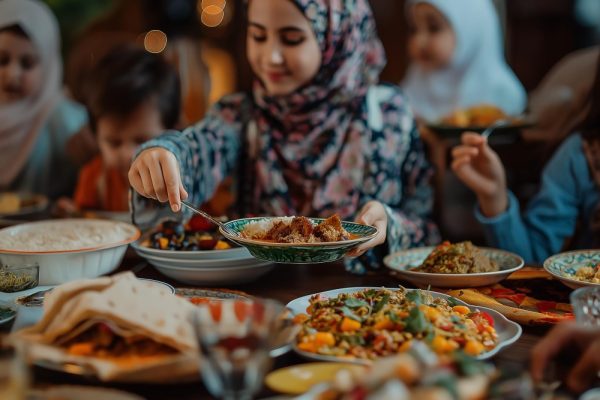
The best halal office catering does not feel like a compromise. It feels like a well-planned meal that everyone is happy to eat. This is important in mixed office groups, where the wrong catering approach can accidentally split guests into “safe for some people” and “better for everyone else.” Halal buffets are often successful because they avoid that divide and still offer enough variety for different tastes.
This is also where familiar Singapore formats can work in your favour. Nasi Padang-style catering is useful because it naturally supports variety, portion flexibility, and easy service for larger groups. On Landmark’s own content, Nasi Padang is described as a format built around rice and a range of side dishes, while its catering appeal is linked to balanced meals, variety, and easy serving for large groups. In office settings, that translates into a menu style that feels generous without becoming chaotic.
A practical way to think about menu planning is to design for comfort and familiarity first. A halal menu with recognisable staples, multiple side dishes, and clearly presented options will usually perform better than an over-curated spread that looks elegant but leaves guests guessing. That is one reason operators that combine Malay, Indian, and Western halal dishes tend to fit office events well: they widen appeal without forcing separate meal streams.
Run the event-day logistics properly
Once the food is ordered, timing becomes just as important as taste. SFA’s catered-meal guidance is especially valuable here because it explains how quickly food safety can be compromised during transport, setup, and service. Food pathogens multiply rapidly between 5°C and 60°C, hot food should be kept above 60°C, cold food below 5°C, and no food should be kept at room temperature for more than 4 hours from cooking to consumption. In practical terms, that means organisers have less usable buffet time than they often assume.
One detail many offices overlook is that chafing fuel does not magically make food safe for extended periods. SFA specifically notes that canned fuels under chafing dishes are not able to keep food above 60°C and cannot extend shelf life. So if your team is running late, the answer is not to leave the buffet out longer and hope for the best.
A day-of checklist that prevents most problems
On the event day, these are the non-negotiables:
- Ask for delivery no more than one hour before meal time so the food is not sitting out too early.
- Make sure hot food arrives in hot or insulated boxes, and cold food arrives chilled and properly held cold.
- Check that each buffet table or packed meal has a visible time stamp and consume-by information.
- If the event runs for several hours, request small-batch replenishment or a second delivery instead of placing everything out at once.
- Do not keep leftovers beyond the consume-by time, and do not encourage staff to pack food for later if that time has passed.
This is where good organisers distinguish themselves. Guests may never notice that you timed delivery well, kept the buffet covered, or arranged a second replenishment. But they absolutely notice when the line is messy, the food is lukewarm, or latecomers are left with a buffet that should have been cleared earlier.
Common mistakes that can quietly undermine a halal office event
The first mistake is treating halal as a last-minute dietary adjustment. If you only ask about halal after choosing the caterer, you have already reversed the right order. In Singapore, halal status should be one of the first filters because MUIS certification and the MUIS directory are how guests and organisers verify suitability with confidence.
The second mistake is assuming that certification alone covers all operational risk. It does not. Halal assurance and food-safety approval are related, but they are not the same system. A strong office catering process checks both MUIS certification and SFA approval or track record.
The third mistake is choosing the wrong service format. Buffets are attractive, but they are not ideal for every office. If guests are spread across floors, released in waves, or restricted by meeting timings, packet meals or staggered delivery are often the more reliable choice under SFA’s own guidance.
The fourth mistake is letting the food arrive too early. SFA explicitly advises delivery at most one hour before meal time, and its guidance also makes clear that staged replenishment is better for long events than exposing all food at once. If you remember only one logistics rule from this article, remember that one.
Conclusion
Organising halal catering for office events in Singapore is not difficult, but it does require a more disciplined approach than simply choosing dishes from a brochure. The best events start with proper verification through MUIS, move on to SFA approval and track-record checks, and then match the catering format to the real pace of the event. Once those foundations are in place, menu planning becomes easier and the guest experience becomes much stronger.
Going forward, the organisers who do this well will be the ones who stop seeing halal catering as a special request and start seeing it as part of good event design. In a mixed office environment, that mindset creates smoother logistics, stronger trust, and a more genuinely inclusive event for everyone at the table. Providers that can combine halal credibility, service flexibility, and venue support will continue to have an edge in that kind of corporate planning.
FAQs
How do I confirm a caterer is genuinely halal-certified in Singapore?
Check the caterer or food preparation area through the MUIS halal establishments listing rather than relying on verbal assurance alone.
Is MUIS certification enough when booking office catering?
No. You should also confirm the caterer is approved by SFA to conduct catering and, ideally, review its SFA track record or SAFE grade.
Are home-based food sellers suitable for office halal catering?
No. SFA states that home-based food businesses are not allowed to offer catering services such as buffet lines or packed meals.
Should I choose a buffet or packet meals for an office event?
Choose a buffet when most guests will eat together. Choose packet meals when meal times are staggered, guests are spread across floors, or the event flow is tightly scheduled.
How early should catered food arrive?
SFA advises requesting delivery at most one hour before meal time to reduce the time food is left out before guests eat.

Comments are closed.