Choosing a Malay wedding venue is never just about finding a beautiful room. In practice, the venue has to carry the weight of the entire day: the akad nikah, the family dynamics the halal dining experience, the bersanding setup, the guest flow and all the small ceremonial details that can either feel seamless or stressful. In Singapore, many Malay-Muslim couples now prefer a more practical celebration by combining key moments such as the nikah, walimah, and bersanding into one day, which makes venue choice even more important. A space that looks elegant online can still fall short if it cannot support witnesses, prayer needs, outfit changes, queue flow, or the pelamin setup properly.
A strong venue should do two things at the same time: respect the emotional and cultural meaning of the day, and quietly solve operational problems before they happen. That is the difference between a celebration that feels calm and one that feels rushed. For couples planning a Malay wedding in Singapore, this is the checklist that matters most.
Start with the wedding format before you judge the venue
The first question is not “Do we like the ballroom?” It is “How will our wedding actually run?” If you plan to hold the solemnisation onsite, the venue must support more than décor. Singapore’s Muslim marriage process requires key participants and documents to be in place, including the bride, groom, wali if applicable, and two witnesses, and the witnesses must be present for the solemnisation. For an offsite solemnisation the officiant will check identification details as part of the process, so the venue should be able to provide a quiet, orderly setup with proper seating, privacy, and a working microphone.
Just as important, the venue must fit the customs your family intends to keep. In a traditional or semi-traditional Malay wedding, the reception is not simply a meal. The bersanding typically centers around the pelamin, often includes a groom’s arrival procession such as berarak or kompang, leads into guest congratulations and photo-taking, and may also connect naturally to makan berdamai or family blessing moments. All of that changes what a “good layout” looks like. A ballroom that feels spacious for a corporate dinner can feel cramped when you add a dais, floral arch, procession path, family seating, queueing guests, and photographers.
Early decisions that shape the right venue
- Whether the akad nikah and reception will happen in the same venue or on different days.
- Whether your family wants a full bersanding entrance with kompang, silat, or a more minimal modern reception.
- How many outfit changes you expect, because that affects the need for a proper bridal room and buffer time.
- Whether your guest experience will be more open and casual, or whether you want clearer zoning for family, VIPs, or more private seating areas.
Confirm Muslim-friendly essentials before anything else
Before comparing chandeliers, stage styling, or package add-ons, confirm the basics that cannot be compromised. In Singapore, MUIS provides halal certification services and publishes the official list of halal-certified establishments, so couples should verify whether the venue itself or its food preparation arrangement is formally halal-certified rather than relying on vague terms like “Muslim-friendly.” That one distinction affects trust, family confidence, and the venue’s suitability from the start.
Prayer arrangements matter too, especially for daytime events or receptions that stretch across several hours. A venue does not need to be extravagant here, but it should have a practical and respectful solution, whether that is an onsite prayer area, a musollah or a clearly planned alternative. The same applies to bridal privacy. A proper room for touch-ups, outfit changes, and brief quiet moments can make the difference between a composed schedule and a stressful one. Some venues now package these needs in from the beginning; for example, Landmark’s own current package materials list a prayer area, bridal table setup, VIP service table, and dedicated marriage-related tables as included items rather than afterthoughts.
The non-negotiables to confirm on your first venue call
- Is the food arrangement halal-certified and verifiable through MUIS or official documentation?
- Is there a proper prayer space for guests?
- Is there a private bridal room close to the main event area?
- Can the venue comfortably support the wali, witnesses, officiant, and document flow for an onsite solemnisation?
- Can the room be arranged in a way that respects your family’s preferred level of privacy or separation?
Judge the venue by guest comfort and movement, not just by appearance
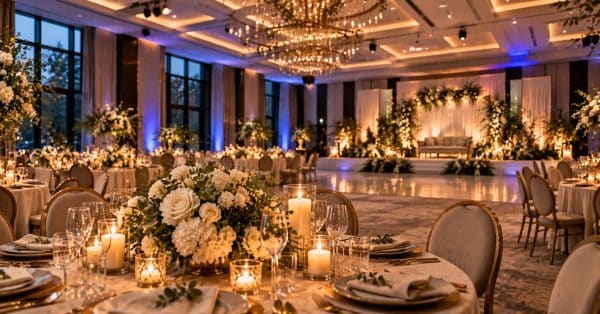
A Malay wedding can look visually stunning in photos and still feel uncomfortable in real life if movement is poorly planned. SingaporeBrides notes that many Malay wedding receptions are buffet-style with flexible seating and no fixed table plan, which means flow becomes critical. Guests need to move easily between the entrance, reception table, buffet line, seating area, and photo queue without blocking the pelamin or crowding elderly family members. The best venues make this feel natural. The weaker ones create bottlenecks.
Guest comfort also has a Singaporean dimension. The local climate is warm, humid, and rainy throughout the year, so sheltered access, indoor comfort, and a sensible drop-off point are not small details. They directly affect older guests, children, formal attire, makeup, and the overall mood of the event. If your couple portraits, kompang entrance, or receiving line involves any movement between spaces, weather protection should be part of the venue discussion from the beginning.
Accessibility deserves the same level of attention. A venue should not only be beautiful for the bride and groom; it should be easy for grandparents, young children, and relatives carrying gifts or favours. Parking, lift access, short walking distances, and a straightforward arrival experience matter more than couples sometimes expect. Landmark’s own wedding planning guidance, for instance, explicitly recommends checking parking, wheelchair access, and at-door drop-off practicality before booking.
Read the package like an operator, not like a brochure
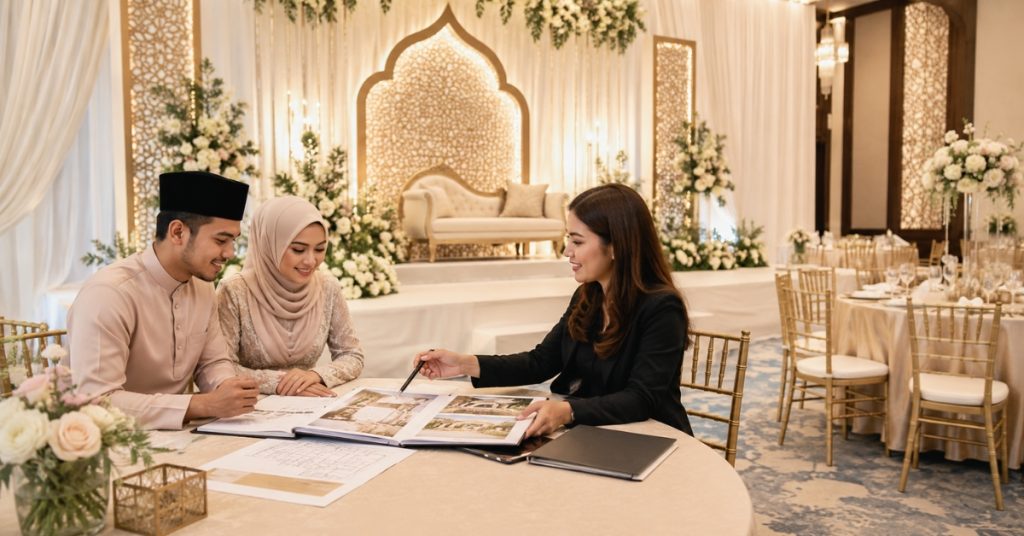
This is where many couples miss expensive details. A package may seem generous until you ask the operational questions: How many hours do you truly get? When can vendors load in? Is the décor inclusive of the pelamin structure or only basic styling? Does the AV cover microphones and projector screens? Is food tasting included? Are parking coupons included? Is the prayer area already designated? Are invitation cards or bridal services part of the package or not? These are not “small print” issues; they determine how many extra vendors, rental items, and coordination calls you will need.
Landmark’s current package PDFs are a useful example of what couples should look for when evaluating any venue. Its solemnisation package includes exclusive venue usage within a set lunch or dinner slot, pelamin decorations with platform and skirting, buffet service, soft drinks, coffee and tea, projector screens, sound system, car park coupons, prayer area, bridal and VIP tables, and nikah-related support tables. Its larger Sayang package adds items such as bridal services, invitation cards, food tasting, and a one-night stay at Village Hotel Bugis. That kind of clarity is valuable because it helps couples see what is already handled and what still needs budgeting.
The more important lesson is this: always look for what is not included. Traditional elements can carry separate costs even when the brochure looks comprehensive. In Landmark’s Sayang package, for example, “duit kipas” is specifically excluded. Live stations are also priced separately. More broadly, SingaporeBrides notes that Malay wedding decoration often begins two to three days before the wedding, while some venue packages only provide access within a same-day function window. That means couples should ask clearly about vendor installation times, teardown deadlines, and whether the décor team can work ahead of guest arrival without rushing.
Questions to ask before you pay the deposit
- What is the actual usable time for setup, guest arrival, ceremony, dining, photography, and teardown?
- Which parts of the pelamin and reception styling are included, and which require external vendors?
- Are prayer space, microphones, projector screens, and family tables already built into the package?
- Which tradition-related items may still cost extra, such as live stations, custom décor, kompang, or duit kipas-related arrangements?
- What happens if your guest count changes, your witnesses change, or your ceremony runs later than expected?
Match the venue to the scale and mood of your celebration
One of the most common mistakes couples make is choosing a venue size based on ambition instead of actual guest behavior. A solemnisation-focused event needs intimacy, sightlines, and calm. A large bersanding reception needs buffer space, stage visibility, and queue control. Those are different design problems. The right venue is the one whose scale matches the feeling you want, not the one that simply sounds more prestigious on paper.
This is where flexible venue options become more useful than one oversized hall. Landmark’s wedding page currently shows a Malay solemnisation package starting from a minimum of 50 persons, while its broader reception packages scale upward for larger guest counts. Its venue page also lists multiple spaces with different capacities, including The Landmark Ballroom and smaller rooms, which is helpful for couples who want to match room size more precisely to event format. Even if you do not choose Landmark specifically, this is the right model to look for: a venue that can fit your wedding rather than forcing your wedding to fit the venue.
Real event photos are another underrated decision tool. A floor plan rarely shows how the pelamin, buffet, guest queue, and family seating feel once the room is styled and occupied. Landmark itself advises couples to ask for photos of previously hosted weddings, and that advice is worth applying everywhere. Photos from real events show whether the room still feels balanced after décor, stage pieces, and actual guests are added.
What this checklist looks like when applied to The Landmark in Bugis
For couples shortlisting venues in Singapore, The Landmark in Bugis stands out most clearly where many venues are weakest: package transparency and cultural practicality. The wedding page positions the venue for Malay, Indian, Middle Eastern, and multicultural weddings, and its current materials show that it is not just selling a room, but a structured event setup. The Malay solemnisation package begins at 50 guests, while the wedding page also lists larger Malay wedding package tiers. The package inclusions go beyond dining and décor to cover essentials such as the pelamin, prayer area, AV support, guest book, money box, car park coupons, bridal and VIP service tables, and dedicated nikah, cake, dulang, and berkat tables.
That matters because modern Malay weddings in Singapore increasingly reward convenience, simplicity, and well-coordinated logistics. When a venue can support the solemnisation, reception styling, buffet service, prayer needs, and family-facing ceremonial moments inside one system, couples have fewer handoffs to manage across multiple vendors. Landmark’s package structure reflects exactly that kind of all-in-one approach. Still, the smart move is to treat even a strong package as a starting point, not a final answer: confirm the timing, verify inclusions, ask about exclusions, and make sure the actual room layout suits your family’s style of celebration.
Conclusion
The best Malay wedding venue is not the one with the prettiest brochure. It is the one that understands how a Malay wedding actually works. That means halal confidence, solemnisation readiness, a proper pelamin layout, comfortable guest flow, prayer arrangements, family privacy, and package clarity. When those pieces come together, the venue stops being a source of stress and becomes a quiet support system for the day.
The direction of Malay weddings in Singapore is already clear: couples are leaning toward celebrations that are practical, culturally respectful, and easier to manage in one place. Venues that can handle both tradition and modern convenience will keep becoming more attractive. For couples evaluating options such as The Landmark in Bugis, the smartest approach is simple: do not just ask whether the venue looks good. Ask whether it can carry the full reality of your wedding day, from akad nikah to the last family photo.
FAQs
What is the first thing a couple should check in a Malay wedding venue?
Check whether the venue can genuinely support a Muslim wedding from a practical standpoint: halal food arrangements, solemnisation logistics, prayer space, and family-friendly setup. Everything else comes after that.
Can a Malay solemnisation and reception be held in the same venue?
Yes, and many couples prefer that for convenience. But the venue must be able to handle the solemnisation flow properly, including space for the wali, witnesses, officiant, and document checks, before it can work well as a reception venue.
Why is the pelamin layout so important?
Because the pelamin is not just décor. It shapes the bersanding moment, guest photo-taking, procession flow, and how the room feels during the reception. If the layout is wrong, the whole event can feel crowded or awkward.
Is “Muslim-friendly” the same as halal-certified?
Not necessarily. In Singapore, couples should verify halal status through MUIS documentation or the official halal-certified establishments listing rather than relying only on marketing language.
What should a good wedding package include?
At minimum, look for venue time, dining, pelamin-related setup, AV support, prayer arrangements, bridal space, and the core tables and service areas needed for the ceremony and reception. Good packages make these details explicit.