
A successful event starts long before guests arrive. The venue decision affects almost everything that follows: how people enter the event, how comfortably they move around, whether presentations run smoothly, how food is served, how easily suppliers can set up, and whether the atmosphere supports the purpose of the occasion.
This is why choosing a venue based mainly on appearance or headline capacity can create problems later. A room may technically accommodate your guest list but leave too little space for a stage, buffet line or registration desk. Another venue may look impressive but require extra spending on audiovisual equipment, furniture or catering.
The better approach is to treat venue selection as part of event planning itself. When comparing an event venue and space rental in Singapore, look beyond the room and consider how the entire event will work inside it from arrival to the final guest departure.
Start With the Event Experience You Need to Create
Before requesting quotations, define what needs to happen during the event.
A 100-person seminar and a 100-person networking reception have the same number of attendees but completely different space requirements. Seminar guests need good sightlines, comfortable seating, presentation equipment and perhaps tables for writing. A reception needs open circulation space and convenient access to food and drinks. A wedding requires yet another arrangement, with dining, ceremonies, photography and family movement all competing for space.
Map the programme before choosing the room
Create a simple sequence of the event:
Arrival and registration → opening programme → main activity → breaks or dining → networking or entertainment → departure.
Then identify what physical space each stage requires.
For example, a corporate conference may need a registration table outside the main room, theatre-style seating during presentations, space for refreshments during breaks and an area where guests can speak comfortably afterward. Planning this flow first makes it much easier to recognise whether a venue actually fits the programme.
Choose Capacity According to the Layout, Not the Maximum Number
One of the most useful venue-planning principles is to stop treating capacity as a single number.
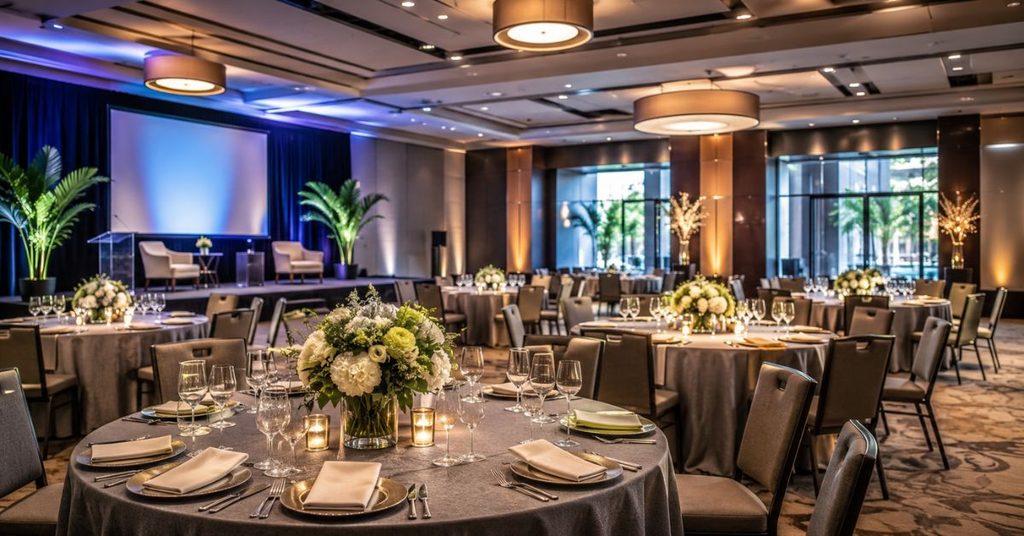
The same room can accommodate very different numbers of people depending on whether guests are standing, sitting at banquet tables or facing a stage in theatre-style seating.
The Landmark’s event venue options illustrate the difference clearly. Red Velvet is listed for up to 180 people in a standing cocktail arrangement, 150 seated or 120 in theatre style. Sapphire is listed for 120 standing, 100 seated or 80 theatre-style guests. The larger Landmark Ballroom configuration is listed for 280 standing, 250 seated and 200 in theatre style.
That variation matters because your usable capacity becomes smaller once you introduce additional event elements.
A 150-person room may not comfortably host 150 diners if you also require a stage, photo wall, buffet stations, audiovisual control equipment and generous walking space.
Leave room for the event to function
Avoid choosing a venue that fits your confirmed attendance only when every seat is occupied.
Instead, account for:
- A stage or presentation area
- Registration and welcome space
- Buffet or refreshment stations
- Equipment and technical areas
- Accessible circulation routes
- Photography, entertainment or displays
- Comfortable movement between tables or seats
A slightly larger or more flexible room often produces a better experience than squeezing guests into the smallest technically acceptable space.
Evaluate the Entire Guest Journey
Your event experience starts before anyone enters the function room.
A venue can offer excellent interiors and still create frustration if guests struggle to reach it, locate parking or understand where to enter.
Make arrival simple
For events in Singapore, MRT access can make a significant difference, particularly when attendees are travelling from different parts of the island.
The Landmark, for example, is located at Village Hotel Bugis on Victoria Street. Its contact and directions page places the venue about a five-minute walk from Bugis MRT via Exit B and also provides bus, taxi and driving information, including parking locations within the building. Village Hotel Bugis likewise identifies Bugis MRT as a short walk from the hotel.
When sending invitations, provide more than the venue name. Include the nearest MRT exit, recommended drop-off point, parking information and the floor or room guests should proceed to.
That small amount of preparation reduces late arrivals and prevents your organising team from spending the first 30 minutes answering direction-related calls.
Walk through the event from a guest’s perspective
During a site visit, physically follow the route your attendees will use.
Where will registration happen? Will a queue block the entrance? Can elderly guests reach the room conveniently? Where will people go during breaks? Can guests find the washrooms easily? Will diners returning from the buffet interfere with speakers or performers?
These details are difficult to judge from photographs. A site visit lets you see whether the venue works operationally, not simply aesthetically.
Treat AV, Wi-Fi and Technical Support as Essential Infrastructure
Technical requirements should be discussed before signing the venue contract, not during the final week of planning.
For a seminar, conference, product launch or company presentation, sound and visual problems can undermine an otherwise well-organised event within minutes.
The Landmark’s corporate event offering highlights audiovisual systems as part of its corporate facilities, while its event-space information also lists seminar essentials such as flipcharts, markers and notepads alongside AV facilities.
Before booking any venue, clarify exactly what “AV included” means. A projector may be included while an operator is not. Microphones may be available, but perhaps not enough for your planned panel discussion.
Confirm the number of microphones, screens, projectors and connection types available. Ask whether Wi-Fi is suitable for your expected number of users and whether technical assistance will be available during the event.
If presentations, videos or speeches are important, arrange a technical rehearsal. Testing the actual laptop, presentation deck, audio files and microphones at the venue is considerably safer than assuming compatible equipment will work on the day.
Plan Catering Around the Programme and the Guests
Catering is not simply a menu decision. It affects timing, room layout and guest movement.
A buffet placed in the wrong part of a ballroom can create long queues. A meal scheduled immediately after a presentation can cause a sudden rush to the dining area. Coffee served too far from a networking space can interrupt conversations rather than support them.
Build food service into the event flow from the beginning.
Consider dietary requirements early
Singapore events often bring together guests from different cultural and dietary backgrounds. Finding out about dietary requirements early can make catering far easier to manage.
If Halal catering is required, for example, working with a venue that already handles it can remove an additional layer of coordination. The Landmark publishes an international Halal buffet menu covering international, local, Western, seafood and Indian selections and displays MUIS certification information on its site.
For weddings and multicultural family celebrations, the venue’s experience with different event traditions can also matter. The Landmark’s wedding venue information specifically discusses Malay, Indian, Middle Eastern and multicultural celebrations.
Regardless of venue, confirm vegetarian, allergy-related and other special meal arrangements well before the final headcount.
Compare the Total Event Cost, Not Just Venue Rental
The cheapest room quotation is not necessarily the cheapest event.
One venue might charge less for rental but require separate suppliers for projectors, microphones, furniture or catering. Another may initially look more expensive but already include services you would otherwise have to source individually.
Ask every shortlisted venue to quote on the same requirements so that you can compare them fairly.
Look at room usage hours, setup and teardown time, AV equipment, technical support, tables and chairs, catering minimums, staffing, cleaning, parking arrangements and any overtime charges. Also confirm whether advertised prices are subject to service charges, taxes or minimum attendance requirements.
This approach gives you a realistic cost per guest rather than an incomplete room-rental figure.
Use the Site Visit to Stress-Test Your Plan
A venue tour should be treated as a working session rather than a sightseeing appointment. Bring your programme, estimated attendance and list of suppliers with you.
Ask practical questions such as:
- Where can organisers and vendors load or store equipment?
- How early can the team enter for setup?
- Can the layout be changed if attendance increases or decreases?
- Where will registration, catering and entertainment be positioned?
- What AV equipment is permanently installed?
- Is technical support available throughout the event?
- Are there restrictions on decorations, stages, signage or external vendors?
- Where are emergency exits and accessible routes?
- What happens if the programme runs beyond the booked time?
- Who will be your venue contact on the actual event day?
For events involving substantial booths, stages or temporary installations, also confirm whether additional safety approvals are necessary. Singapore’s SCDF notes that certain temporary event setups can carry specific fire-safety requirements, including keeping escape routes unobstructed.
A professional venue team should be able to explain what is permitted within the space and what organisers or vendors need to arrange separately.
Build Flexibility Into the Venue Choice
Guest numbers change. Speakers cancel. Presentations run late. Suppliers encounter delays. Even carefully organised events rarely unfold exactly as originally planned.
The right venue gives you room to respond.
Flexible room configurations can help when attendance changes. Built-in AV equipment reduces dependence on additional deliveries. In-house catering can simplify schedule adjustments. Indoor alternatives become especially valuable if any part of the programme depends on weather.
Ask yourself what would happen if 20 additional guests confirmed, the keynote speaker needed a different presentation setup or registration took twice as long as expected.
If every minor change would require rebuilding the event plan, the venue is probably too restrictive.
Confirm Everything Before the Event Day
Once the venue has been selected, convert discussions into a written event plan.
Your final confirmation should cover the room, layout, guest count, timing, catering, AV requirements, signage, supplier access and organiser contact details. Send the final programme to the venue team and identify who has authority to make decisions on the day.
A final walkthrough is particularly useful for larger events. Stand where the registration team will stand, test the presentation position, check the dining flow and confirm where suppliers should report.
By this stage, there should be very few unanswered questions.
Conclusion
The best event venue is not necessarily the largest, newest or most elaborate. It is the venue that fits the purpose of your event and removes unnecessary friction for organisers and guests.
Start with your programme, choose capacity according to the actual layout, test the guest journey, confirm technical requirements, integrate catering into the schedule and compare complete costs rather than headline rental prices. Then use a site visit to verify that the plan works in the real space.
For organisers comparing options in Singapore, reviewing The Landmark’s event venue and space rental facilities provides one example of how location, configurable rooms, catering and corporate-event facilities can be considered together rather than as separate decisions.
Going forward, flexibility is likely to become even more valuable as events increasingly combine presentations, networking, dining and interactive experiences within a single programme. Venues that can adapt comfortably between those activities will give organisers far more freedom to create events that feel polished rather than merely accommodated.
Frequently Asked Questions
How far in advance should I book an event venue in Singapore?
Book as soon as your date, approximate guest count and event format are reasonably certain. Popular dates and larger spaces can be harder to secure, particularly when your event has specific catering or technical requirements.
How do I know what size venue I need?
Use your expected attendance together with your planned layout. Include space for the stage, buffet, registration, AV equipment and guest circulation rather than choosing a room based only on its maximum capacity.
What should be included in an event venue quotation?
Confirm room rental, setup time, furniture, AV equipment, Wi-Fi, staffing, catering, parking arrangements, overtime charges, service charges and applicable taxes so that you can compare venues on total cost.
What facilities are most important for a corporate event?
Reliable AV equipment, suitable Wi-Fi, comfortable seating, clear sightlines, convenient transport access, catering options and adequate space for registration and breaks are usually the most important considerations.