
You do not always need a separate room for breakout discussions. Short conversations around existing tables can work well when everyone follows the same programme and the topics are not confidential. Separate rooms become more useful when groups need privacy, different presentation equipment or sustained concentration.
For an event in Singapore, the decision should come before you confirm the seating layout and venue booking. Adding another room affects cost, equipment and movement between sessions. Keeping everyone together affects how comfortably participants can hear and contribute.
The right question is: what must each group accomplish, and what conditions will help them do it?
When One Room Is Enough
A shared room often suits brief discussions that feed directly into the main session. Participants might compare experiences, respond to a speaker’s question or agree on three suggestions before reporting back.
This arrangement works best when:
- Everyone starts and finishes the activity together.
- Groups can speak at normal conversational volume.
- Participants do not need separate audio or video.
- The subject can be discussed openly.
- Tables have enough separation for neighbouring conversations.
For example, a team planning session could alternate between presentations and ten minutes of discussion at each table. Keeping people seated avoids repeated transitions and lets the facilitator clarify instructions for everyone.
However, a room that comfortably accommodates an audience may feel crowded once people turn their chairs, spread out worksheets and begin talking.
When a Separate Room Adds Real Value
Sensitive conversations
Budget negotiations, staff feedback and client matters may require more privacy than a table at the edge of a ballroom provides.
A separate room helps only if its sound separation and access arrangements support the conversation. Ask whether speech carries through partitions or connecting doors, and whether unrelated guests or service staff will pass through.
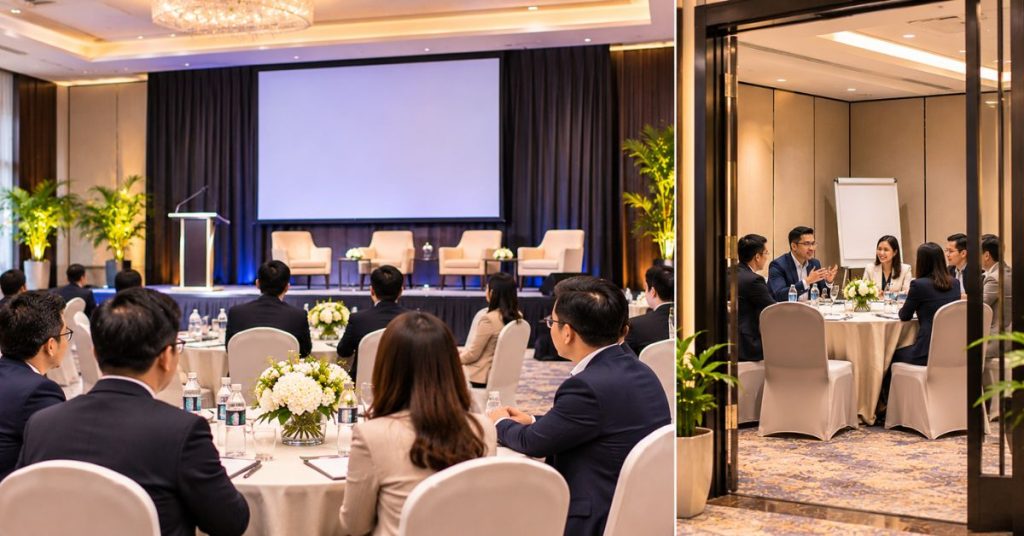
Different activities happening simultaneously
One group watching a demonstration while another debates a proposal creates competing demands. The demonstration needs clear audio; the discussion needs uninterrupted conversation.
Separate spaces allow each activity to operate at a suitable pace without one group repeatedly waiting for another.
Longer sessions with detailed outputs
Groups developing action plans, reviewing documents or resolving complex questions need working space as well as seats. They may need to leave notes on a board or keep materials arranged throughout the session.
A dedicated room can also help facilitators support quieter participants who struggle to contribute against background conversation.
Check the Discussion Layout, Not Just Capacity
The Landmark’s event venue page lists the following room dimensions and theatre capacities. These provide a starting point for comparing spaces, but they do not establish breakout capacity.
| Event space | Published dimensions | Published theatre capacity |
| Red Velvet | 41 × 49 ft | 120 |
| Sapphire | 39 × 36 ft | 80 |
| The Landmark Ballroom | 85 × 36 ft | 200 |
Theatre seating places attendees in rows. Discussion tables require a different arrangement, with space for chairs, materials and people moving between groups.
Ask for a proposed floor plan showing your actual group sizes. Include presentation equipment, refreshment areas and clear circulation routes.
Also confirm whether the spaces you want can be booked and operated independently at the same time. Do not assume that every named space represents an additional room available alongside the others.
Test Sound Before Committing
An empty room can seem quiet while giving little indication of how several simultaneous conversations will sound.
During a site visit, have people speak from two proposed discussion positions. Listen from a seated position and check whether you can follow your own group without raising your voice. This will not fully reproduce an occupied event, but it can reveal obvious problems.
Ask about noise from neighbouring functions, background music and service areas. If a partition is involved, check it in its closed position.
Screens and decorative dividers can create visual separation without providing meaningful speech privacy. For confidential sessions, explain the requirement clearly rather than simply requesting a “private corner”.
Give Every Group a Practical Working Setup
Room allocation should follow the task. A conversation needs comfortable seating; a planning exercise may also need writing surfaces, power access and somewhere to display decisions.
The Landmark’s linked seminar brochure lists cluster, theatre and classroom arrangements, along with items such as flipcharts, whiteboards, Wi-Fi and presentation equipment. Confirm the current package and the quantities allocated to each booked room.
When discussing event venue rental, specify:
- How many people will work in each group?
- Whether each group needs a screen or board.
- Whether laptops require nearby power.
- Whether any participants need accessible seating or quieter conditions.
Equipment included for the main presentation should not be assumed to cover every breakout space.
Allow Time to Move and Report Back
A thirty-minute agenda slot does not necessarily provide thirty minutes of discussion. Instructions, movement, settling in and returning to the main room all take time.
Allocate groups before the session begins and display clear room names. Give each facilitator the same written task, finishing time and reporting format.
For a straightforward activity, an illustrative forty-minute slot could include:
- Five minutes for instructions and movement.
- Twenty-five minutes for discussion.
- Five minutes to record decisions.
- Five minutes to return.
Adjust this after checking the actual route and participants’ access needs. Allow a separate slot for group reports.
Keep refreshments away from essential movement routes, and agree when staff can enter rooms so service does not interrupt the discussion.
Compare the Complete Cost of Both Options
Request two quotations based on the same programme: one using discussion tables in the main room, and another including separate space.
Compare room hire, equipment, furniture changes, staffing and access time. If the main room needs rearranging during a break, confirm how long that takes and where participants will wait.
A second room may save repeated furniture changes across a full-day workshop. For one short discussion, it may add expense without improving the result.
If suitable rooms are unavailable, consider staggering groups, shortening the activity or collecting individual written responses before a shared discussion.
Five Frequently Asked Questions
1. How many people should be in each breakout group?
Four to six is a practical starting point for a discussion where everyone should contribute. Adjust for the task, available time and facilitation support.
2. Can breakout discussions take place at dining tables?
Yes, provided there is enough space for materials and service is paused. Clear used crockery before the activity begins.
3. Does every group need a facilitator?
Not always. Simple tasks can use a nominated timekeeper and spokesperson. Sensitive or complex discussions benefit from a dedicated facilitator.
4. Can a foyer serve as a breakout area?
Only if the venue permits it and the area offers suitable seating, manageable noise and clear access. Avoid it for confidential conversations.
5. What should an organiser send with a venue enquiry?
Send the agenda, attendance, group sizes, session timings, equipment requirements and privacy needs. Include any accessibility requirements affecting room placement or movement.