Choosing a halal banquet venue in Singapore is not just about finding a pretty room with enough tables. For many hosts, the venue has to solve two things at once: it must give Muslim guests complete confidence in the food, and it must make the event feel smooth from arrival to the last plate served. That is why venue selection affects more than aesthetics. It shapes trust, turnout, comfort, and how easily the day runs for families, couples, and corporate organizers alike. In Singapore, MUIS regulates the halal industry and provides an official directory for halal-certified establishments, which means hosts have a clear way to verify claims instead of relying on vague marketing language.
This matters even more for banquets because a large event magnifies every small problem. If the halal status is unclear, guests may hesitate to eat. If the venue is hard to reach, late arrivals start piling up. If the package looks affordable but hides add-ons, the budget can unravel quickly. A good halal banquet venue should remove those doubts early, not leave them for the week before the event.
Start with the certification, not the décor
The first filter should always be halal verification. MUIS provides halal certification services, regulates the Singapore halal industry, and directs consumers to search halal-certified establishments through its official platform. That makes certification the most practical starting point when comparing venues. If a venue looks beautiful but cannot clearly show how its food operation is certified, it should not make your final shortlist.
A detail many people miss is that MUIS uses different certification schemes for different food operations. The Eating Establishment scheme applies to places such as restaurants, while the Food Preparation Area scheme is issued to catering establishments and central kitchen facilities. In real-world terms, that means you should ask which exact entity is certified: the venue’s in-house restaurant, the off-site caterer, or another kitchen handling your food. That distinction matters because a banquet can take place in one location while the food is prepared and certified under another operation.
It is also smart to confirm that the certificate is current, not just historically mentioned on a website. MUIS states that halal certificates are valid for one or two years, and certified businesses remain subject to post-certification checks such as unannounced inspections. For hosts, the practical takeaway is simple: ask to see the current certificate and cross-check the establishment through the MUIS directory before paying a deposit.
What to verify before you shortlist a venue
- Ask whether the certified party is the restaurant itself or an external caterer / central kitchen. MUIS separates these under different schemes, so the answer should be specific.
- Check that the business name on the quotation matches the certified operation you were shown.
- Confirm that the certificate is current, since MUIS certificates run for fixed validity periods and require renewal.
- Verify the venue or caterer in the official MUIS halal establishments directory, rather than relying only on brochure wording.
Choose a venue around your guests, not just your theme
Once certification is clear, think about the guest journey. In Singapore, convenience can be the difference between a calm event and a stressful one. A banquet venue should be easy to reach by MRT, simple to locate for ride-hailing and family drivers, and manageable for elderly guests, children, and people carrying gifts or event materials. If people struggle just to arrive, the event already feels harder than it should.
A central Bugis example shows why this matters. Village Hotel Bugis lists Bugis MRT Station as a short walk away and highlights its proximity to Sultan Mosque, while Landmark’s own event pages emphasize public transport access and parking. That combination is useful because it supports both practical logistics and Muslim guest comfort, especially for events that run across prayer times or bring together guests from different parts of Singapore.
Prayer convenience is often underestimated until the day itself. For a lunch wedding, family celebration, or corporate function that spans several hours, guests may need a nearby prayer space. Landmark’s own event-planning guidance explicitly points to mosque proximity as a key consideration for halal events, and Village Hotel Bugis identifies Sultan Mosque as nearby. Even if your venue has a dedicated prayer room, it is still worth checking how easy it is to access, how private it feels, and whether older guests can reach it comfortably.
Judge the food operation not only the menu card
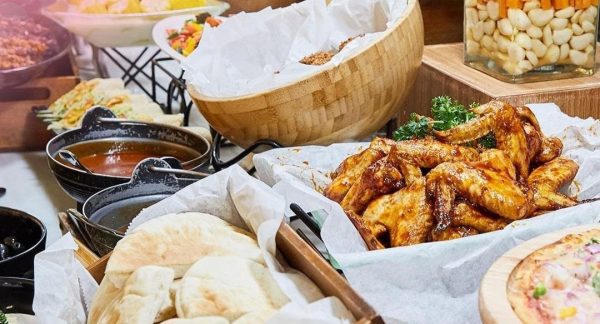
A banquet menu should do more than sound impressive on paper. It should match the event type, the guest profile, and the way people actually eat at functions. A family wedding may call for familiar crowd-pleasers, while a corporate banquet may benefit from a broader spread that works across age groups and preferences. Landmark’s published menu highlights a wide mix of international, local, Western, seafood, and Indian cuisines, while its catering guidance stresses the value of including multiple protein options, vegetarian dishes, staples, sides, desserts, and beverages. That is the right way to think about banquet food: not as a long list, but as a balanced experience that helps every table find something comfortable and satisfying.
Menu flexibility matters almost as much as menu variety. If a venue cannot explain whether dishes can be adjusted to your event style, your guest count, or your service format, the food program is probably less mature than the brochure suggests. Landmark’s wedding and event content repeatedly emphasizes custom buffet packages and customizable menu options, which is exactly the kind of operational flexibility a host should look for when planning anything larger than a casual dinner.
It is also worth looking past the food names and asking how the meal will actually be delivered. Will the buffet line move smoothly? Will dishes be replenished quickly? Can the team manage a mixed crowd of elders, children, and VIP guests without the room feeling chaotic? These questions often separate a venue that is merely halal-certified from one that is genuinely banquet-ready. A confident venue should be able to walk you through this without sounding vague.
Read the package like a contract, not a brochure
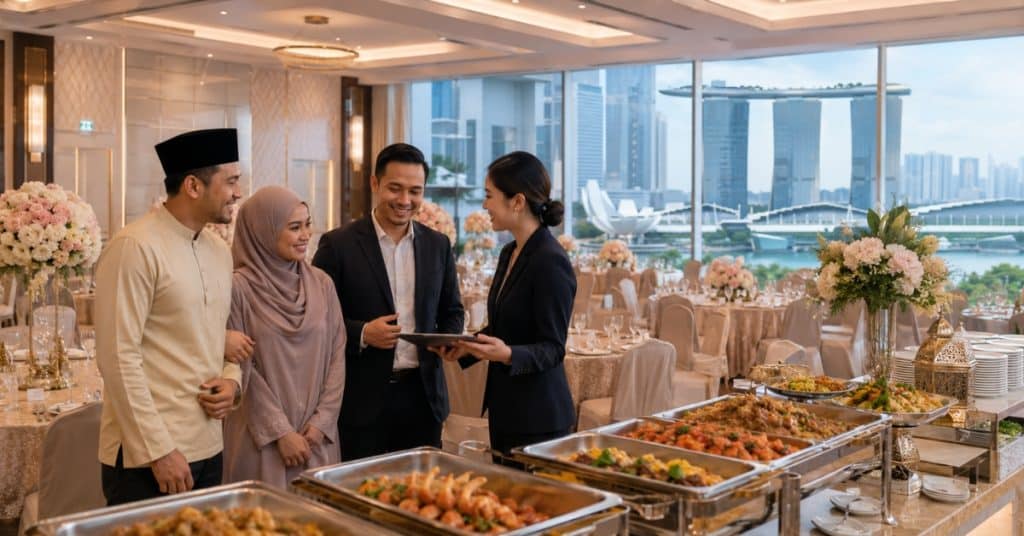
One of the easiest ways to overspend is to compare packages that are priced in different ways. Some venues advertise starting prices per person, while others emphasize package totals, minimum guest counts, or quoted prices before taxes and service charges. A serious banquet comparison should always move from brochure pricing to a full written breakdown. Otherwise, you may think you are comparing three similar offers when you are actually comparing three completely different scopes.
Landmark’s own pages are a useful example of the type of transparency hosts should demand. Its event pages publish starting prices and minimums for multiple formats, including a solemnization package from 50 persons, a wedding package from 250 persons, seminar pricing with minimum attendance thresholds, and buffet pricing shown in both “++” and nett formats on the dining menu. Even if you are not booking that specific venue, this is the right standard to expect: visible guest minimums, a clear pricing basis, and enough detail to tell whether the quote fits your event before you start negotiating.
The strongest packages are the ones that reduce ambiguity. If your banquet depends on AV support, décor, staging, high tea, or special room setup, do not assume those are included. Landmark’s corporate event materials, for example, explicitly mention items such as flipcharts, markers, audio-visual systems, notepads, and options for high tea, snacks, and lunch in certain packages. That level of specificity helps planners avoid budget surprises.
What a clear quotation should include
- The pricing basis: per person, per table, or package total.
- The minimum guest count and what happens if attendance falls short.
- A nett total, not only a “++” figure, so you can compare venues fairly.
- The exact included items: room use, AV, décor, staffing, buffet setup, beverages and any add-ons.
- The event duration and overtime or change fees if your program runs longer than planned.
A practical shortlist for your final site visit
By the time you visit a venue in person, your job is no longer to be impressed. Your job is to confirm that the place works. Walk the route your guests will actually use. Check whether older relatives can move easily from drop-off to dining space. See whether the room feels cramped with banquet seating, not empty in showroom mode. Stand where the emcee or solemnisation table would be. Look at where the buffet line would form. A good site visit turns vague confidence into observable proof.
This is also the moment to test whether the venue team communicates clearly. Landmark’s venue materials mention three event spaces, audio-visual systems, parking, and access to public transport. Those are useful features, but the real question during any visit is whether the team can explain how those features support your event flow. In other words, you are not just inspecting a ballroom. You are assessing whether the venue thinks like an event partner.
A practical venue will usually become obvious during this walk-through. The staff answer directly. The quote matches what you see. The halal status is easy to verify. The room layout makes sense. The access story is simple. When those pieces line up, you are far less likely to face last-minute friction.
The best halal banquet venue is the one that removes doubt
The smartest way to choose a halal banquet venue in Singapore is to work in layers. Start with verified MUIS certification. Then test guest convenience through transport, parking, and prayer access. After that, examine the food operation, not just the menu language. Finally, compare packages with the discipline you would use for a contract, not the optimism you might bring to a brochure. That approach protects both experience and budget.
In practice, venues stand out when they make each of those checkpoints easy. That is why central, clearly positioned options such as Landmark at Village Hotel Bugis are useful examples to study: the venue publicly states its address, accessibility, halal positioning, menu range, event package structure, and several starting price points. Even if you end up booking elsewhere, that is the standard worth using. The right halal banquet venue should not make you chase certainty. It should make certainty visible from the start.
FAQs
How do I verify that a banquet venue is really halal-certified in Singapore?
Ask to see the current certificate and cross-check the venue or caterer in the official MUIS halal establishments directory. MUIS also notes that certificates have fixed validity periods and require renewal.
Is a halal-friendly venue the same as a halal-certified venue?
Not always. In Singapore, the safer standard is MUIS certification. You should also confirm whether the certified operation is the restaurant itself or the external caterer preparing the food.
What matters more for a banquet: the menu or the location?
Both matter, but certification comes first. After that, location affects attendance and guest comfort, especially when MRT access, parking, or nearby prayer facilities make the event easier to attend.
Is Bugis a practical area for a halal banquet?
It can be. Village Hotel Bugis lists Bugis MRT Station as a short walk away and highlights proximity to Sultan Mosque, while Landmark promotes the same address as a halal event and dining venue. That combination makes the area especially convenient for many Muslim guests.