Planning a halal banquet in Singapore involves more than choosing a menu without pork or alcohol. Guests need confidence in how the food is sourced, prepared, stored and served, while the organiser still has to manage the usual pressures of venue capacity, budget, accessibility, programme timing and service flow.
That is why the best approach is to settle the halal requirements first, then build the rest of the banquet around the guest experience. Whether you are organising a wedding reception, corporate dinner, family celebration or community event, the following steps will help you avoid the problems that tend to appear only after invitations have gone out.
Confirm the Halal Standard Before Comparing Packages
Start by establishing what “halal” needs to mean for your event.
In Singapore, MUIS administers halal certification. Its certification framework distinguishes between eating establishments such as restaurants and food preparation areas used by caterers and central kitchens. MUIS also emphasises separation from non-halal substances during preparation, processing, storage and transportation.
For an organiser, the practical lesson is simple: do not rely only on descriptions such as “halal-friendly”, “no pork” or “Muslim-owned” when your guests expect formal halal assurance.
Before paying a deposit:
- Check the establishment’s current halal certification status.
- Confirm that the certificate applies to the location supplying your food.
- If an outside caterer is involved, verify the caterer’s certification separately.
- Ask how outside cakes, desserts, food gifts or other edible items are handled.
- Reconfirm the halal arrangements shortly before the event, especially if you booked many months ahead.
The Landmark identifies its restaurant at Village Hotel Bugis as MUIS Halal Certified on its current website, making halal assurance a central part of its dining and event proposition.
Fix Your Guest Count Before Choosing the Banquet Space
A common planning mistake is falling in love with a ballroom before the guest list is realistic.
Start with three numbers: the expected attendance, the comfortable maximum and the absolute limit. Then select a room using its seated banquet capacity, rather than its standing or theatre-style capacity.
For example, The Landmark’s event venue options currently list:
- Sapphire: up to 100 seated guests
- Red Velvet: up to 150 seated guests
- The Landmark Ballroom: up to 250 seated guests
The published capacities are different for cocktail and theatre configurations, so organisers should match the figure to the layout they actually intend to use.
Leave Space for Movement, Not Just Chairs
A room that technically seats 150 people may feel crowded once you add buffet lines, a registration table, photo backdrop, stage, AV equipment, gifts or a dessert station.
Think about movement from the guest’s point of view. Can an elderly relative reach the buffet comfortably? Can servers replenish dishes without cutting through a queue? Is there enough room for a wheelchair? Can guests move between tables while someone is giving a speech?
A slightly larger room with better circulation often creates a more polished banquet than a smaller space filled to its maximum capacity.
Design the Menu Around the Guest List
Once halal assurance and capacity are settled, focus on menu composition.
Singapore banquet guest lists are often multigenerational and multicultural. A wedding table might include grandparents who prefer familiar Malay or local dishes, younger guests looking for Western food, children wanting something mild and corporate guests with vegetarian or other dietary requirements.
Instead of trying to impress people with the sheer number of dishes, aim for useful variety.
A well-rounded buffet could include:
- one or two substantial rice or noodle options;
- chicken, beef or mutton;
- seafood;
- vegetables and a clearly suitable meat-free dish;
- milder choices alongside spicy dishes;
- familiar local flavours;
- desserts, fruit and hot and cold beverages.
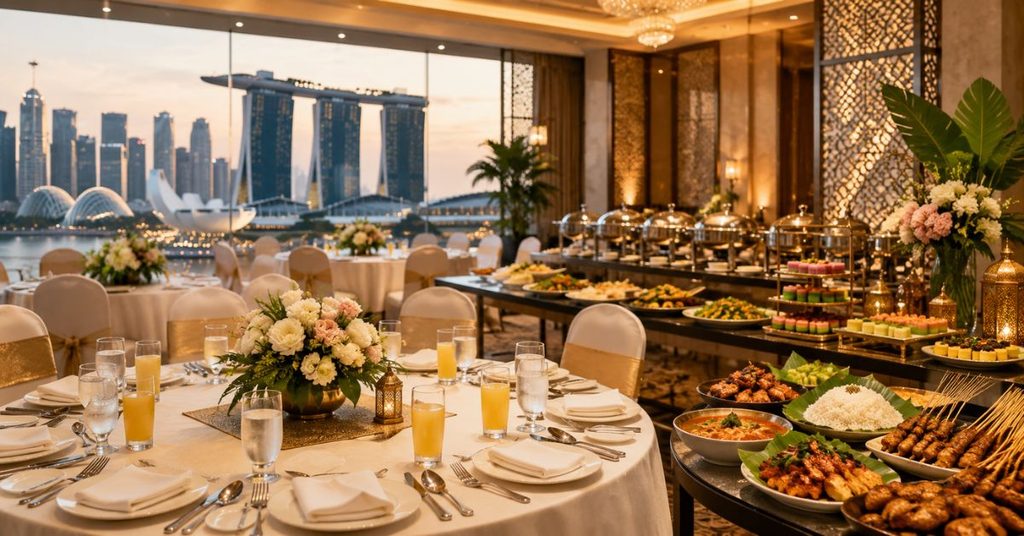
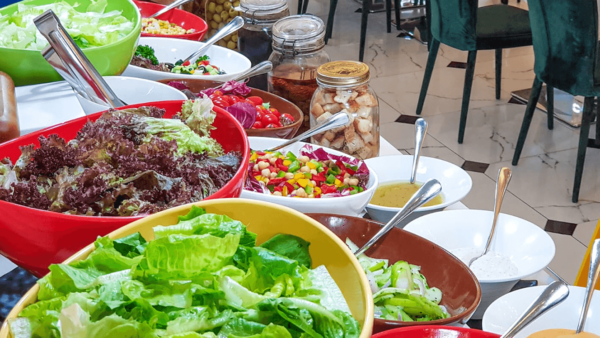
The Landmark’s international halal buffet menus illustrate this type of variety. Its rotating menus bring together local dishes, Indian selections, seafood, Western food, salads, desserts and live stations. Individual menus feature combinations such as beef rendang, chicken dishes, briyani, fish curry, seafood, pasta, naan and traditional kuih.
Ask About Dietary Needs Separately
Halal does not automatically mean suitable for every dietary requirement.
Ask guests early about food allergies, vegetarian preferences and other restrictions, then discuss them with the venue. If special meals are prepared separately, decide how staff will identify the correct guest without causing confusion during service.
This is particularly important for corporate banquets, where organisers may not know every attendee personally.
Plan the Buffet Flow Before Finalising the Menu
Food quality matters, but buffet logistics can determine whether guests actually enjoy it.
Imagine 150 people being invited to one buffet line at the same time. Even an excellent menu can become frustrating when guests spend the first part of dinner queueing.
For larger groups, ask whether the venue can create multiple access points or separate popular sections. Salads, mains, live stations, desserts and beverages do not necessarily need to occupy one continuous line.
Live stations require extra thought because individual preparation takes time. The Landmark’s regular menus, for example, feature stations such as satay, carving and, on selected weekend dinners, poolside BBQ items.
For your banquet, discuss expected throughput with the event team rather than simply adding every available live station.
The goal is to create theatre without creating a bottleneck.
Build Prayer and Religious Considerations Into the Programme
For a Muslim-friendly banquet, timing deserves as much attention as the menu.
Check the prayer times for the actual event date when building the programme. If your banquet overlaps with a prayer period, avoid placing an important speech, solemnisation segment, award presentation or other unmissable moment at the same time.
Ask the venue in advance whether an appropriate prayer space and ablution facilities are available or what nearby arrangements guests normally use. Do not wait until guests arrive to work this out.
This becomes especially important during Ramadan. An iftar banquet needs a different flow from a conventional dinner: guests should be able to break their fast promptly, perform prayers where necessary and return to the main meal without the programme moving ahead without them.
For events around Bugis, location can also be useful when planning guest movements. The Landmark is at Village Hotel Bugis, 390 Victoria Street, and its website highlights its central Bugis location.
Choose a Venue Based on the Whole Event, Not Only the Food
A banquet venue has to support everything happening around the meal.
For a corporate dinner, that might include presentations, microphones and screens. For a wedding, it could mean a dais or stage, photography, entrances and family seating. A birthday or anniversary may need space for decorations, a cake table and entertainment.
Ask the venue about:
Audio-Visual Requirements
Find out what is included and what costs extra. Test microphones, presentation screens, music connections and video playback before guests arrive.
The Landmark’s corporate event facilities describe seminar and event arrangements that can include audio-visual systems and other meeting equipment, which is useful if a banquet includes presentations or formal proceedings.
Access and Arrival
Check public transport access, parking arrangements, lift access and the route guests will take from the entrance to the ballroom.
Arrival becomes particularly important when you have elderly relatives, young children, VIPs or guests wearing formal attire. A smooth five-minute arrival experience is more valuable than an impressive venue that is difficult to navigate.
Clarify Rules for External Vendors and Food
Decorators, photographers and entertainers generally present little concern from a halal perspective. Food vendors require more attention.
Before bringing in an external wedding cake, dessert cart, coffee station, food favour or catering supplier, ask the venue whether it is permitted and what halal documentation is required.
MUIS certification requirements are concerned not only with ingredients but also with preventing cross-mixing during handling, storage and transportation. For certified catering operations, MUIS specifically sets controls around food delivery, event setup and situations where halal and non-halal food are both present.
That means an innocent last-minute decision such as a relative arriving with an outside dessert can create an issue that would have been easy to avoid with advance approval.
Compare Packages Using the Final Cost, Not the Headline Price
Per-person pricing is useful for initial comparisons, but it is not the banquet budget.
The Landmark’s current banquet and celebration information, for example, displays selected celebration and seminar packages from $55++ per person with minimum attendance requirements. Published pricing and minimums can change, so organisers should request an event-specific quotation rather than treating an advertised starting price as the final cost.
When comparing quotations, ask for one figure covering everything you expect to use, including room hire, food, service, AV equipment, additional staffing, decorations, overtime and any other event charges.
Also clarify:
- minimum guaranteed attendance;
- when the final guest count is due;
- deposit and payment schedule;
- cancellation or postponement terms;
- children’s pricing;
- charges for extra hours;
- vendor setup and teardown timings.
A package that looks slightly more expensive at first can be better value if it already includes items that another venue charges separately.
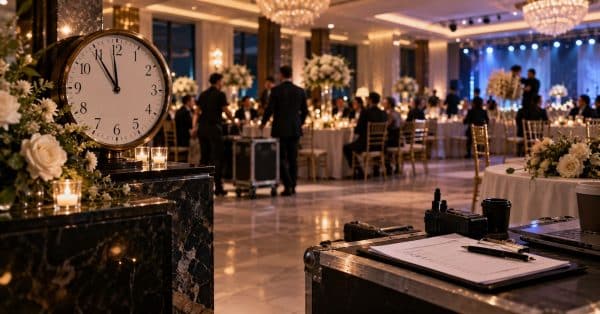
Create a Realistic Banquet Timeline
Your event programme should work around food service rather than fighting against it.
A practical sequence might be:
Guest arrival → registration or reception → opening programme → buffet opens → main dining period → speeches or entertainment → dessert and photographs → closing
Avoid scheduling your most important speech five minutes after opening the buffet. Guests will either ignore the speaker or leave their food getting cold.
Likewise, ask the kitchen when dishes are intended to be served. If the programme runs 30 minutes late, food quality can suffer even when the kitchen has done everything correctly.
For weddings, The Landmark also provides dedicated wedding venue and package information for Malay, Indian, Middle Eastern and multicultural celebrations, which can help couples compare a purpose-built wedding arrangement with a more general banquet package.
Do One Final Operations Check Before the Event
About one to two weeks before the banquet, bring every moving part together with the venue coordinator.
Confirm the final headcount, table plan, dietary requests, menu, programme, vendor timings and AV requirements. Reconfirm your halal-related arrangements as well, especially if outside food suppliers are involved.
Then conduct a final walkthrough mentally—or physically if possible—from the moment the first guest arrives until the last vendor leaves.
You are looking for small problems: an undersized registration area, a buffet queue blocking the ballroom entrance, a microphone with no backup, unclear prayer arrangements or a cake delivery arriving while nobody is authorised to receive it.
These details are much easier to solve before the room is full.
Conclusion
A successful halal banquet in Singapore comes from treating halal assurance as part of the entire event operation rather than as a single menu requirement.
Begin with verified halal arrangements. Then choose a room that genuinely fits your guest count, build a menu around the people attending, design an efficient buffet flow and coordinate prayer considerations, AV needs, vendors and programme timing before the event day.
Venues that combine halal dining with dedicated function spaces can simplify that process because fewer elements need to be coordinated across separate suppliers. The Landmark, for example, combines a MUIS Halal Certified dining operation with private event spaces of different capacities, international buffet choices and dedicated wedding and corporate event options.
The best banquet is not necessarily the one with the most dishes or the largest ballroom. It is the one where guests can arrive, eat, worship when needed, socialise and enjoy the occasion without having to think about the planning happening behind the scenes.
Frequently Asked Questions
How do I check whether a banquet venue in Singapore is halal certified?
Check the establishment against MUIS halal certification information and confirm that the certification applies to the actual outlet preparing and serving your food. Recheck close to your event date because certification status can change.
How many guests can The Landmark’s event rooms accommodate?
Its published venue information lists Sapphire for up to 100 seated guests, Red Velvet for up to 150 and The Landmark Ballroom for up to 250. Capacity varies with the room configuration.
Can I bring an external cake or caterer to a halal banquet?
Possibly, but always obtain the venue’s approval first. Ask what halal certification or documentation is required and how outside food will be received, stored and served.
Is a buffet or plated meal better for a halal banquet?
Neither is automatically better. Buffets suit groups wanting wider menu choice, while plated meals offer tighter timing and portion control. For a large buffet, good queue and station planning is essential.
Comments are closed.