Choosing an event venue based on attractive photos, a convenient package, or the biggest capacity number is an easy mistake to make. A venue can look impressive and still be wrong for what guests actually need to do once they arrive.
A seminar needs clear sightlines and reliable presentation equipment. A wedding needs smooth movement between ceremony, dining, photography, and speeches. A product launch needs space for guests to circulate without losing focus on the main presentation. A family celebration may depend more on privacy, food choices, and comfortable seating than on production equipment.
The better approach is to choose the venue from the event format backwards. Decide how people will use the space, then look for a venue that supports that experience naturally. In Singapore, factors such as MRT access, parking, catering requirements, guest accessibility, and room configuration can make that fit even more important.
Start With What Your Guests Will Actually Be Doing
Before comparing venues, describe your event in terms of activity rather than simply giving it a label.
Two “corporate events”, for example, may require completely different rooms. A management seminar involves long periods of listening and note-taking. A networking reception depends on movement and conversation. A product launch may begin with cocktails, move into a presentation, and finish with demonstrations or dinner.
Ask yourself:
- Will guests spend most of the event seated, standing, dining, moving around, or switching between formats?
- Is there one main focal point, such as a speaker, stage, screen, couple, or product?
- Do you need uninterrupted sightlines and clear audio?
- Will food be served while another part of the programme is taking place?
- Do you need registration, reception, photography, breakout, backstage, or waiting space?
- Does the room need to change configuration during the event?
Once those questions are answered, unsuitable venues become much easier to eliminate.
Choosing a Venue for Weddings and Solemnisations
A wedding venue has to manage several experiences at the same time. It is not enough for the room to hold the guest list.
Prioritise Ceremony and Guest Flow
Think through the wedding from arrival rather than starting with table arrangements. Where will guests wait? How will the couple enter? Where will family photographs take place? Can guests reach the buffet or dining tables without crossing important ceremonial areas?
If the solemnisation and reception take place in the same venue, flexibility becomes especially valuable. The room may need to transition from a ceremony-focused setup to dining and celebration without creating a long interruption.
Consider Cultural and Catering Requirements Early
For Malay, Indian, Middle Eastern, multicultural, and other culturally specific weddings, catering requirements, ceremonial customs, family seating, stage arrangements, and programme timing should be discussed before confirming the space.
The Landmark specifically caters for a range of multicultural celebrations through its wedding venue options in Singapore, including solemnisation and wedding formats.
The right wedding venue, therefore, is not simply the most elegant ballroom. It is the one that allows the ceremony, dining service, family traditions, speeches, entertainment, and photography to work together without guests constantly being moved or organisers improvising around the room.
Choosing a Venue for Seminars, Conferences and Training Sessions
For knowledge-focused events, functionality should take priority over decorative impact.
Choose the Seating Style Before the Room
A theatre setup works well when attendees mainly watch speakers or presentations. Classroom seating is better when people need laptops, notebooks, or training materials. Cluster seating makes more sense for workshops involving group discussions.
This distinction matters because one room can accommodate very different numbers of guests depending on the layout.
The Landmark’s seminar facilities, for example, support configurations such as theatre, classroom, and cluster seating, alongside presentation equipment, screens, microphones, Wi-Fi, and seminar support items. Its corporate event and seminar options are designed around meetings, conferences, and related business functions rather than treating every corporate gathering as a banquet.
Check the Experience From the Back of the Room
During a venue inspection, stand where the last attendee will sit.
Can you clearly see the screen? Would text on a presentation be readable? Can a speaker be heard without excessive volume? Are there pillars or awkward angles? Is there room for participants to enter or leave without distracting everyone else?
These practical tests tell you more about a seminar venue than photographs ever will.
Choosing a Venue for Product Launches and Networking Events
Product launches and networking sessions are often more dynamic than traditional conferences, so they need a different type of space.
Protect Both Movement and Attention
Networking works best when people can move naturally between conversations. A tightly packed banquet layout can make that difficult. On the other hand, an excessively large room may disperse guests so much that the event loses energy.
For a launch, identify where attention needs to shift throughout the programme. Guests might first mingle, then gather around a stage or screen, followed by product demonstrations or refreshments.
That means you should assess:
Circulation space. Can groups form without blocking entrances, food stations, or the presentation area?
Presentation infrastructure. Is the stage, screen, sound system, lighting, and electrical access suitable for the launch?
Branding opportunities. Can you place backdrops, displays, signage, demonstration stations, or branded installations where guests will actually see them?
Setup access. If products, exhibition structures, or equipment need to arrive before the event, confirm how loading and installation will work.
A venue with a flexible layout will usually outperform a rigid room even when both have similar floor areas.
Choosing a Venue for Birthdays, Anniversaries and Family Celebrations
Private celebrations require less formal production than many corporate events, but guest comfort becomes even more important.
Match the Room to the Social Atmosphere
For an intimate anniversary dinner, an oversized ballroom may make a small gathering feel disconnected. For a milestone birthday with entertainment, photography, children, and a buffet, a restaurant table alone may become restrictive.
Look for a space that gives guests somewhere to gather naturally without making the event feel either crowded or empty.
Food also plays a bigger role in family celebrations because the guest list may include several generations and different dietary needs. Reviewing the venue’s dining arrangements before booking helps avoid the common problem of choosing the room first and trying to make the menu work afterwards.
For celebrations where halal dining is important, The Landmark offers an international halal buffet menu and identifies its Bugis restaurant as MUIS halal certified.
Choosing a Venue for Workshops and Team-Building Events
Workshops are participation-focused, so conventional conference-room assumptions do not always work.
Look for Flexibility Rather Than Formality
Participants may need to move between presentations, small-group discussions, exercises, and shared activities. Fixed seating or tightly packed banquet tables can quickly become frustrating.
Prioritise movable furniture, usable wall or presentation areas, reliable Wi-Fi, comfortable working space, and enough room for facilitators to circulate between groups.
Breaks matter too. A full-day workshop without convenient refreshments or a practical place for attendees to step away can feel much longer than the programme itself. If meals and coffee breaks can be coordinated within the same venue, organisers have fewer moving parts to manage.
Match Capacity to the Layout, Not Just the Guest Count
Capacity figures can be misleading when viewed without context.
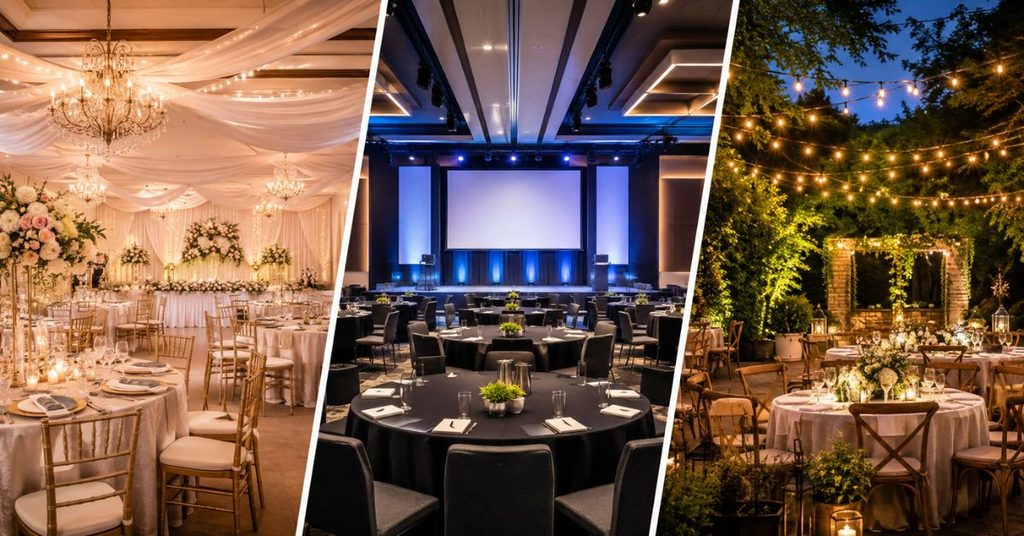
A room advertised for a large number of guests may reach that figure only in a standing configuration. Once you add banquet tables, a stage, AV equipment, registration areas, buffet stations, or presentation seating, usable capacity changes considerably.
The Landmark’s event venue comparison page illustrates this clearly:
- Sapphire: up to 120 for a standing cocktail format, 100 seated, or 80 theatre-style.
- Red Velvet: up to 180 standing, 150 seated, or 120 theatre-style.
- The Landmark Ballroom: up to 280 standing, 250 seated, or 200 theatre-style.
The published figures show why planners should compare rooms using the specific layout required for the event, rather than choosing according to one maximum-capacity number.
A 100-person networking reception and a 100-person seminar do not use 100-person rooms in the same way.
For Multi-Format Events, Choose a Venue That Can Adapt
Some of the hardest events to match with venues are those that change character during the programme.
Consider a corporate appreciation evening that starts with registration and cocktails, continues with a presentation, and finishes with a buffet dinner. Or a wedding that moves from solemnisation to photography and then into the reception.
In these cases, ask whether the venue can be divided, combined, or reset efficiently.
Having access to differently sized rooms can also help when attendance is uncertain. The Landmark, for example, offers Sapphire and Red Velvet as individual spaces as well as the larger Landmark Ballroom configuration, giving planners different capacity options rather than forcing every event into one room size.
This type of flexibility is particularly useful when one part of the programme needs a different atmosphere from another.
Factor in How Guests Will Reach the Venue
Location should be judged from the guest’s perspective, not simply from a map.
For a weekday business event, a difficult journey can lead to late arrivals and disrupt the programme. For weddings and family gatherings, elderly guests, families with children, and people travelling from different areas of Singapore may need both public transport and driving options.
The Landmark is located at Village Hotel Bugis on Victoria Street. Its directions indicate that it is around a five-minute walk from Bugis MRT, with bus connections and on-site parking available in the building.
When comparing any Singapore venue, follow the entire journey: MRT exit to venue entrance, taxi or ride-hailing drop-off, parking to ballroom, and lift or accessibility routes. A venue that is technically “central” may still create unnecessary friction if the final part of the journey is inconvenient.
Compare the Total Event Experience Before You Book
Once you have narrowed the options according to event type, perform one final comparison based on outcomes rather than marketing features.
Check:
- Room fit: Does the venue work comfortably in your actual seating or standing configuration?
- Guest flow: Can people move between registration, dining, presentations, photography, and exits without bottlenecks?
- Technical readiness: Are the required microphones, screens, sound, Wi-Fi, lighting, and power arrangements confirmed?
- Catering fit: Does the food arrangement suit your guests, programme timing, and dietary requirements?
- Access: Is the venue practical for guests arriving by MRT, car, taxi, or ride-hailing service?
- Operational support: Who will handle room setup, programme changes, food service, AV issues, and last-minute requests?
Conclusion
The best venue is not necessarily the largest room, the most luxurious ballroom, or the package with the lowest headline price. It is the venue that makes your particular event easier to execute.
For weddings, that may mean privacy, cultural suitability, catering, and smooth transitions between ceremonial moments. For seminars, it means sightlines, seating, and dependable AV. For launches and networking events, circulation and presentation flexibility become critical. For family celebrations, food, comfort, and atmosphere carry more weight. Workshops need room to interact rather than simply room to sit.
Define what guests will actually experience before you compare spaces. Then assess capacity according to the required layout, inspect the complete guest journey, and confirm what the venue can support operationally.
As events become more experience-driven, flexible venues will have an increasing advantage over spaces designed around a single fixed format. Choosing according to event type from the beginning does more than help you find a suitable room it removes unnecessary compromises from everything that follows.
FAQs
What should I consider first when choosing an event venue?
Start with the event format. Decide what guests will be doing—such as dining, watching presentations, networking, or participating in activities before comparing room sizes and packages.
Should I choose a venue based on maximum capacity?
No. Compare capacity using your actual layout. Theatre seating, banquet tables, classroom setups, and standing receptions all use the same room differently.
What type of venue is best for a corporate seminar?
Choose a venue with clear sightlines, suitable theatre or classroom seating, reliable Wi-Fi, microphones, screens, presentation equipment, and convenient break arrangements.
What matters most when choosing a wedding venue in Singapore?
Look at guest flow, privacy, seating, catering requirements, cultural or ceremonial needs, accessibility, transport convenience, and how easily the venue can transition between different parts of the celebration.