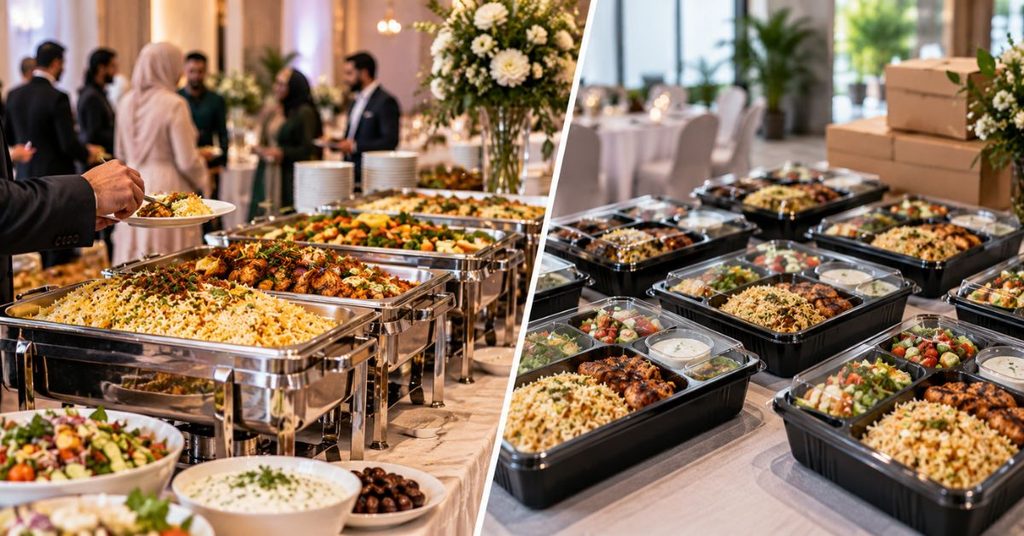
Choose bento when your event needs quick meal distribution and a predictable restart. Choose a buffet when guests have a shared dining break, room to move and time to enjoy the selection. The deciding factor is how food service fits between the activities on your programme.
For a Singapore office workshop, family celebration or community gathering, start with the timetable before selecting dishes. A generous spread can become frustrating if guests spend their break queuing. Equally, individually packed meals may feel too structured when lunch is the main opportunity to mingle.
Here is how to match the format to the time you actually have.
Start with the Usable Meal Break
A scheduled lunch break includes more than eating. Guests must leave their seats, reach the food, collect their meal, find somewhere to sit and return before the next activity.
For example, a workshop running from 9am to 5pm may allow only 30 minutes for lunch. Once movement and distribution are included, the comfortable eating window becomes much shorter.
Use these scenarios as planning examples, rather than fixed service guarantees:
| Event schedule | Format to consider | Main scheduling advantage |
| Short lunch between training sessions | Bento | Meals can be distributed without individual serving decisions |
| Longer lunch with networking | Buffet | Guests can choose dishes and continue conversations |
| Staff taking breaks in groups | Bento | Portions can be allocated to each group |
| Celebration with a defined dining period | Buffet | Food becomes part of the shared occasion |
| Different rooms following separate agendas | Bento | Meals can be organised by room |
Headcount matters too. A small group may move through a buffet quickly, while a large group can overwhelm one bento collection desk.
Choose Bento When the Programme Must Restart on Time
Bento suits events where each person needs a complete meal with minimal coordination at lunchtime. Think training courses, examination teams, production crews or meetings with a tightly scheduled afternoon session.
Its practical advantage is portion allocation. Organisers can count meals against attendance, separate confirmed dietary orders and send the correct quantities to different rooms.
However, boxes do not distribute themselves. If every guest must give a name and choose between several options at one table, the collection process can still cause delays.
Before the break, arrange meals by room, team or preselected option. Keep drinks and cutlery easy to collect, and assign someone to handle exceptions without stopping the main line.
Bento also needs an appropriate eating space. Guests balancing containers on their laps may save time collecting lunch but have a less comfortable meal.
Choose a Buffet When Dining Is Part of the Occasion
A buffet works well when the meal has its own place in the programme. At a celebration or networking lunch, choosing food and returning for another serving can be part of the experience.
The schedule must accommodate the last person served, not just the first. A lunch that opens at 12.30pm does not give everyone a full hour to eat if the final guests reach the dishes much later.
Discuss the serving layout before confirming the format. Where space and equipment allow, access from both sides or duplicated serving points may reduce bottlenecks. Position drinks separately so they do not interrupt the food queue.
Also clarify what “buffet delivery” includes. Delivered sharing trays and a staffed buffet with equipment have different setup requirements. Ask about tables, warming arrangements, serving utensils, replenishment and collection.
Build the Delivery Plan Backwards from Mealtime
Give the supplier your required ready-to-eat time, then agree on the arrival window needed to achieve it.
For a buffet, work backwards through setup, unloading and building access. For bento, allow time to check quantities, identify special orders and move meals to collection points.
A simple event brief should include:
- Meal service start and finish times.
- The earliest time the venue permits access.
- Loading instructions, security registration and lift access.
- The exact room or delivery point.
- A named receiver with a working mobile number.
- The deadline for clearing the space.
For Singapore offices and function rooms, a delivery reaching the building entrance is only one stage of the journey. Make the route from vehicle to dining area clear.
Build contingency into access and coordination instead of automatically requesting food much earlier. Agree on handling instructions and what happens if the programme runs late.
Handle Staggered Arrivals with Separate Meal Windows
An event lasting several hours does not necessarily need one continuous food service.
If staff take lunch in successive shifts, bento can simplify allocation. Label quantities by shift and agree on suitable delivery and holding arrangements. Do not assume individually packed food can simply wait until someone becomes available.
For a family gathering, distinguish between guests arriving slightly apart and groups eating hours apart. Those situations need different plans.
Where the gap is substantial, ask whether separate deliveries or service sessions are possible. For iftar, work backwards from the correct breaking-fast time for the event date, allowing for distribution before guests begin eating.
For either format, obtain clear consumption and storage instructions, and assign someone to manage the service end time.
Match the Menu and Quote to the Schedule
Choose dishes with the eating arrangements in mind. Meals requiring extensive cutting, peeling or assembly can be awkward during a short break. Sauces, soups and separate accompaniments also affect distribution and table space.
Collect dietary requirements before the order deadline. Confirm which requests can be accommodated and how those meals will be identified, so guests do not need to resolve them during lunch.
The Landmark’s menu page presents its restaurant buffet selection. Confirm the delivery menu separately rather than assuming restaurant dishes, prices or promotions apply to an off-site order.
Compare complete quotations, including delivery, setup, equipment, staffing, collection and any applicable charges. A lower per-person price is less useful if the arrangement requires extra organisers or disrupts the next session.
Start with The Landmark’s home delivery and self-collection page, then confirm current formats and availability. The page does not currently provide a complete buffet or bento package list.
Frequently Asked Questions
1. Is bento always faster than a buffet?
Bento usually simplifies collection, but distribution still needs planning. Preassigned meals and several collection points can help. A single desk handling names and last-minute choices can create a queue.
2. Can a buffet work for a short lunch break?
Possibly, especially for a small group with a straightforward layout. Check whether everyone can be served and eat comfortably before the restart. For larger groups, consider bento or additional serving points.
3. How early should food arrive?
Agree on the arrival window with the supplier using your meal start time, access conditions and setup needs. There is no single buffer suitable for every venue or food format.
4. Is self-collection suitable for an event?
Yes, if a dedicated person can collect, transport and hand over the food within the agreed schedule. Include travel, parking and unloading time, and confirm suitable transport and handling arrangements.