Choosing an event venue in Singapore is rarely a question of finding a space that looks impressive. The harder and more important decision is finding a venue type that works with the way the event will actually run.
A beautiful rooftop may create the right atmosphere for a networking reception but become complicated when heavy rain arrives. A large convention hall may be ideal for an exhibition but feel unnecessarily empty for an 80-person seminar. Likewise a restaurant may work perfectly for a family celebration yet lack the presentation setup needed for a corporate conference.
The best approach is therefore to match the venue to the event format, guest count, seating arrangement, catering requirements and programme flow. Singapore’s official business-events venue directory itself categorises spaces by capacity, seating style and amenities rather than appearance alone a useful way to think about venue selection.
Here is how the main venue types compare for different events in Singapore.
A Quick Guide to Matching Events With Venue Types
For an initial shortlist, these combinations usually make the most sense:
- Weddings and solemnisations: ballrooms and banquet venues
- Seminars and workshops: function rooms and conference ballrooms
- Corporate town halls and conferences: larger ballrooms or convention venues
- Product launches and networking events: flexible cocktail-style event spaces
- Birthdays, anniversaries and family celebrations: private dining spaces or smaller ballrooms
- Large exhibitions and trade events: purpose-built convention and exhibition halls
- Outdoor celebrations and experiential events: gardens, rooftops or waterfront venues with a reliable wet-weather alternative
The next step is deciding which characteristics matter most for each type of event.
Ballrooms and Banquet Venues Are Best for Weddings and Solemnisations
Weddings need more than enough chairs. The venue has to support arrivals, dining, speeches, ceremonies, photography, entertainment and movement between different parts of the programme.
That makes a ballroom or dedicated banquet venue one of the safest choices for Singapore weddings.
Why Ballrooms Work Well for Wedding Programmes
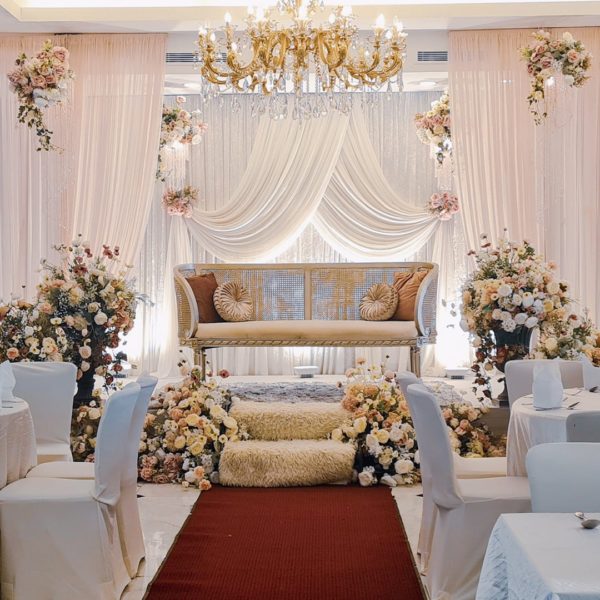
A ballroom gives couples control over seating layouts, stage positioning and dining service while keeping the celebration protected from Singapore’s weather. It is particularly useful when the wedding involves several formal elements rather than a simple meal.
Different ballroom sizes can also produce very different experiences.
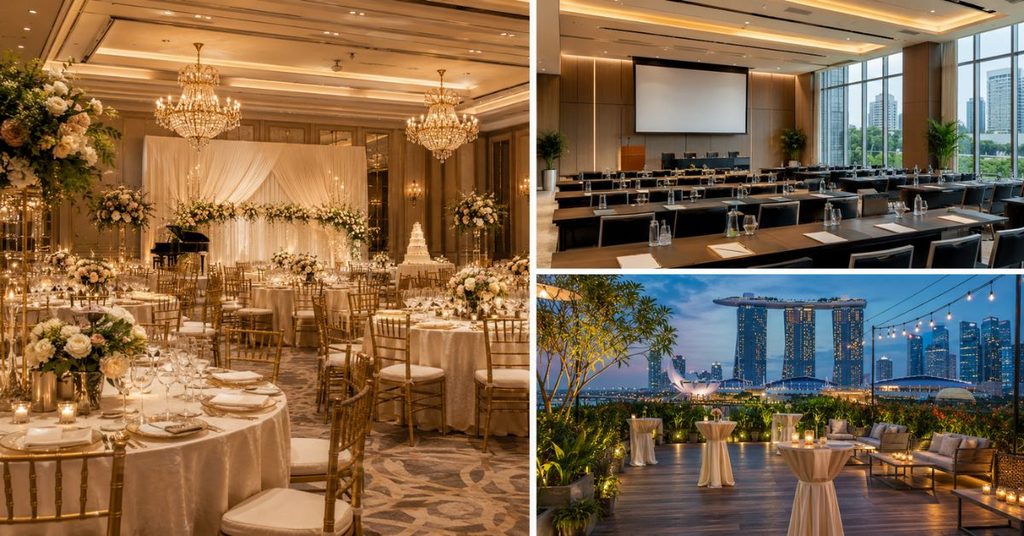
At The Landmark’s event venues, for example, the Sapphire room accommodates up to 100 seated guests, while Red Velvet accommodates up to 150. For larger celebrations, The Landmark Ballroom accommodates up to 250 seated guests or 280 guests in a standing cocktail configuration.
That means couples do not necessarily have to choose the largest available room. A smaller solemnization can feel much warmer in an appropriately sized ballroom, while a larger reception benefits from the additional circulation and dining space of a bigger room.
For culturally detailed celebrations, operational experience matters as much as appearance. The Landmark’s wedding venue options in Singapore specifically cater for Malay, Indian, Middle Eastern and multicultural weddings, including solemnisation and larger reception formats.
Function Rooms and Conference Ballrooms Are Best for Seminars and Workshops
A seminar venue should be selected around concentration and participation rather than decoration.
Guests need to see the screen clearly, hear speakers without difficulty and move comfortably during discussions or breaks. The room should also support the right seating format.
Look for Flexible Seating and Built-In Meeting Essentials
Theatre seating works well when most attendees are listening to presentations. Classroom layouts are better when guests need laptops or notebooks, while clusters encourage group discussion and workshops.
This is where hotel function rooms and smaller conference ballrooms become particularly useful.
The Landmark’s seminar arrangements, for instance, support cluster, theatre and classroom configurations. Its seminar package also includes Wi-Fi, projectors, screens, cordless microphones, a basic AV system, flipcharts, whiteboards and presentation supplies.
Room capacity can then be matched to the programme. Sapphire holds up to 80 guests theatre-style, while Red Velvet accommodates up to 120 in the same arrangement.
For organisers comparing spaces for a training day, workshop or management session, this can be more practical than booking an oversized convention room simply because it has a prestigious address.
You can review the available corporate event and seminar options before deciding which room configuration works for the agenda.
Larger Ballrooms Are Best for Town Halls and Mid-Sized Conferences
Once an event moves beyond a small seminar, the priorities change.
A company town hall, annual meeting or industry conference may require a proper stage, stronger sound coverage, multiple microphones, projection and clear sightlines for a larger audience.
For events of this scale, a larger ballroom is often a better fit than several separate function rooms.
Capacity Should Be Based on Seating Style, Not Maximum Occupancy
One common venue-selection mistake is looking only at the maximum number of guests a room can hold.
A room that accommodates 280 people standing may accommodate substantially fewer when guests require tables or theatre seating.
The Landmark Ballroom illustrates the difference clearly: its published capacity is up to 280 for standing cocktails, 250 seated and 200 theatre-style.
That distinction matters when planning a town hall. A company expecting 190 attendees may fit comfortably in a 200-person theatre configuration but require a different solution if the same group needs banquet tables.
For significantly larger conferences involving hundreds or thousands of delegates, purpose-built convention centres become more appropriate. Singapore’s business-event venues range from hotel meeting rooms to major exhibition facilities, allowing organisers to scale according to programme size.
Flexible Cocktail Venues Are Best for Networking Events and Product Launches
Networking works differently from a seminar. Instead of keeping guests seated and focused in one direction, the venue needs to encourage movement.
That is why flexible event spaces with standing reception layouts are usually better for product launches, media events and professional networking sessions.
Standing Capacity Creates More Space for Interaction
Removing banquet tables can transform the way a room functions.
Guests can move between demonstrations, branded displays, refreshments and conversation areas without feeling that they are abandoning an assigned seat.
At The Landmark, Sapphire has a standing cocktail capacity of 120, Red Velvet accommodates 180, and The Landmark Ballroom accommodates up to 280.
Those variations make it possible to choose the room according to the expected turnout rather than placing every reception into the same large event hall.
For a product launch, organisers should also think beyond guest capacity. Consider where the product reveal will happen, whether media crews need clear sightlines and how easily the room can transition from a presentation into networking.
The available event venue and space rental options are particularly relevant for seminars, product launches, company gatherings and other private corporate functions.
Private Dining Spaces and Smaller Ballrooms Are Best for Family Celebrations
Not every celebration benefits from a grand venue.
Birthdays, anniversaries, engagement parties, baby celebrations and family gatherings often feel better in a smaller space where guests can comfortably interact.
Choose a Venue Where Food and Conversation Can Take Priority
For these events, the dining experience usually matters more than elaborate staging.
A private dining venue or compact ballroom allows organisers to create a defined celebration space without making a relatively small guest list feel lost.
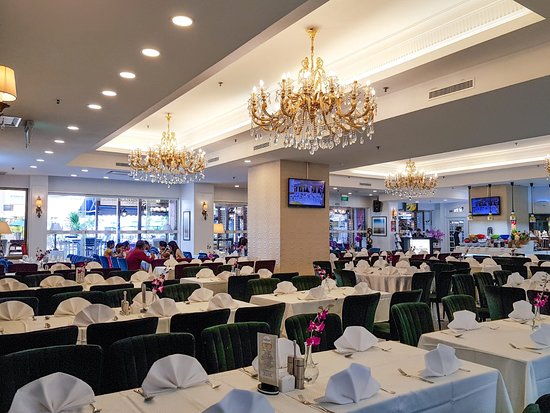
A room such as Sapphire, with seating for up to 100, is better suited to this kind of gathering than a convention-scale venue. Red Velvet provides additional room when the celebration includes more guests, entertainment or a larger buffet setup.
Food requirements should also influence the shortlist early. The Landmark operates as a MUIS Halal-certified establishment and offers international halal buffet dining, making this especially relevant when organisers want one dining arrangement that can comfortably accommodate Muslim guests. MUIS is Singapore’s authority responsible for issuing and regulating halal certification.
Convention and Exhibition Halls Are Best for Trade Shows and Very Large Events
Ballrooms are versatile, but there is a point where a purpose-built exhibition venue becomes the better choice.
Large trade shows, consumer fairs and conferences with several thousand attendees may require loading access, exhibition booths, multiple stages, substantial technical infrastructure and large circulation areas.
Large-Scale Events Need Infrastructure, Not Just Floor Space
Singapore EXPO, for example, has ten interconnected halls and 32 meeting rooms covering 123,000 square metres of indoor and outdoor event space. Individual exhibition halls can accommodate thousands of guests, illustrating why this category of venue exists separately from hotel ballrooms.
Suntec Singapore similarly combines exhibition halls, meeting rooms, a theatre and a multi-purpose ballroom for major conferences and exhibitions.
For an event with 150 or 200 attendees, however, this scale can be unnecessary. A ballroom generally creates a more contained atmosphere and simplifies catering and guest movement.
The best venue is therefore not the venue with the greatest possible capacity. It is the smallest venue type that comfortably handles the full operational requirements of the event.
Gardens, Rooftops and Outdoor Venues Are Best for Experiential Events
Outdoor venues can create an atmosphere that conventional indoor spaces cannot easily reproduce.
They work particularly well for lifestyle launches, cocktail receptions, destination-style weddings, informal networking events and experiential brand activations.
Singapore offers everything from waterfront spaces to major garden venues. Gardens by the Bay, for example, provides both outdoor event locations and indoor alternatives such as Flower Field Hall.
Always Build a Wet-Weather Plan Into the Venue Decision
Singapore’s climate makes backup planning essential.
Local thunderstorms and showers are common forms of tropical precipitation, and some weather systems can produce heavy rainfall with relatively little relevance to how carefully an event has been scheduled.
An outdoor venue should therefore be shortlisted only after answering practical questions such as where guests will move if it rains, how quickly furniture and AV equipment can be protected and whether the backup space can actually accommodate the full guest list.
For events where schedule certainty is more important than scenery—such as seminars, weddings with detailed programmes or corporate presentations—an indoor ballroom may ultimately provide better control.
Team-Building Events Need Flexible Spaces Rather Than One Specific Venue Type
Team-building events are unusual because the programme may alternate between presentations, exercises, meals and informal interaction.
The best venue therefore depends on what the team will actually be doing.
A strategy retreat with group exercises may work well in a ballroom configured with clusters. A highly physical programme may be better suited to an outdoor or recreational destination. A company retreat combining workshops and meals may benefit from an indoor venue where the layout can change throughout the day.
For programmes involving presentations as well as interactive sessions, rooms that can move between classroom, cluster and theatre arrangements are particularly valuable. The Landmark’s seminar offering supports these different configurations along with AV equipment and refreshment options.
The key is to build the venue around the programme rather than trying to redesign the programme around an inflexible room.
How to Choose Between Venue Types in Singapore
Before requesting quotations, define the operational requirements of the event. A useful shortlist should answer these questions:
- How many guests will attend? Compare capacity using the actual layout you need—not simply the venue’s maximum standing capacity.
- What will guests be doing? Dining, presentations, networking and workshops all require different room configurations.
- What technical equipment is required? Confirm screens, projectors, microphones, Wi-Fi, stage requirements and technical support.
- What are the catering requirements? Decide early whether halal certification, vegetarian choices or particular serving formats are important.
- How will guests reach the venue? MRT access, parking and convenience become increasingly important for larger events and mixed-age guest lists.
- Does the programme depend on the weather? Outdoor venues should have a realistic indoor or sheltered contingency plan.
Singapore’s official MICE venue directory uses many of the same practical filters, including capacity, seating style, air conditioning, AV systems, catering, parking, Wi-Fi and wheelchair accessibility.
Conclusion
There is no single venue type that is best for every event in Singapore.
Ballrooms work especially well for weddings, celebrations, seminars, conferences and receptions because they combine privacy with configurable layouts. Smaller function rooms are often better for workshops and intimate gatherings, while convention centres become necessary when an event reaches exhibition scale. Outdoor venues can create memorable experiences, but they require more careful weather planning.
The most useful way to shortlist venues is to start with the programme: guest count, seating style, catering, AV requirements, accessibility and movement through the event.
For organisers considering a centrally located indoor venue for anything from a small seminar to
FAQs
What type of venue is best for a wedding in Singapore?
A ballroom or banquet venue is usually the most practical choice because it supports seated dining, ceremonies, speeches, entertainment and weather-independent planning.
What venue is best for a corporate seminar?
Choose a function room or conference ballroom with flexible seating, reliable Wi-Fi, projection facilities, microphones and suitable refreshment options.
How large should an event venue be?
Choose according to your required layout rather than maximum capacity. A venue may accommodate far fewer guests in banquet or theatre seating than it does for a standing reception.
Are outdoor venues suitable for events in Singapore?
Yes, particularly for weddings, networking events and brand experiences. However, organisers should always secure a practical wet-weather alternative because tropical showers can disrupt outdoor programmes.