Planning a group meal sounds simple until the guest list starts growing. Someone wants firm halal assurance, someone else is coming with elderly parents, a few guests care about easy MRT access, and the organizer still has to think about menu variety, privacy, timing, and budget. In Singapore, that first point matters more than many hosts realize: halal certification is voluntary, so it should be confirmed rather than assumed. MUIS advises diners to verify the original halal certificate at the premises and cross-check the outlet on the MUIS halal establishments listing, while halal-certified businesses are also subject to audits during the certificate validity period and, in some cases, unannounced inspections.
That is why a good group dining experience at a halal restaurant is not only about finding delicious food. It is about choosing a venue that makes the whole event easier to host from the first invitation to the final dessert plate. In Singapore, centrally located halal-certified venues such as The Landmark in Village Hotel Bugis are especially practical because they combine published halal positioning, group-friendly seating, event spaces, and strong transport access near Bugis MRT.
Why group dining needs more than a reservation
A halal group meal usually carries a different kind of responsibility than an ordinary booking. For family reunions, birthdays, company dinners, community gatherings, or celebrations, the person organizing the meal is often making a trust decision on behalf of everyone else. That trust covers the food, of course, but it also extends to privacy, comfort, accessibility, and how smoothly the event runs once guests arrive. Official guidance from MUIS makes that trust issue very practical: certification should be visible at the outlet, and the outlet’s name and location should match the certification details.
This matters for businesses too. A well-planned halal group dinner is not just inclusive; it is operationally smoother. If the venue can handle larger parties, support private seating, and offer built-in event facilities such as sound systems or presentation equipment, the host avoids unnecessary friction on the day itself. Landmark’s corporate event information, for example, highlights tailored packages, audio-visual systems, flipcharts, notepads, and multiple event spaces, which is exactly the kind of support that helps a team lunch, seminar dinner, or client event feel organized rather than improvised.
Start with the format, not the food
Match the space to your headcount
One of the most common planning mistakes is obsessing over dishes before deciding what the gathering actually needs. Start with the size and purpose of the event. Landmark’s own venue guidance recommends private rooms for medium gatherings of around 50 to 150 guests and larger halls or ballrooms for gatherings above 150. On its venue page, The Landmark publishes Red Velvet with seating capacity for 150, Sapphire for 100, and The Landmark Ballroom for 250 seated guests, which gives hosts a useful benchmark when they are trying to avoid cramped tables or wasted space.
For a casual family meal, regular group seating may be enough. For an engagement dinner, school alumni catch-up, community iftar, or company appreciation event, private or semi-private space usually creates a better experience because conversation is easier and the event feels intentional. That is also why privacy keeps coming up in halal event planning guidance: noisy open layouts and mixed public traffic can make a gathering feel less comfortable than the host intended.
Choose the service style that lowers friction
For mixed groups, buffet service usually solves more problems than it creates. A buffet lets guests choose portions, pace their meal, and gravitate toward familiar dishes without making the organizer pre-decide every preference. Landmark’s venue and wedding planning content repeatedly positions buffet dining as the format that gives wider variety and a more relaxed flow, especially for larger gatherings.
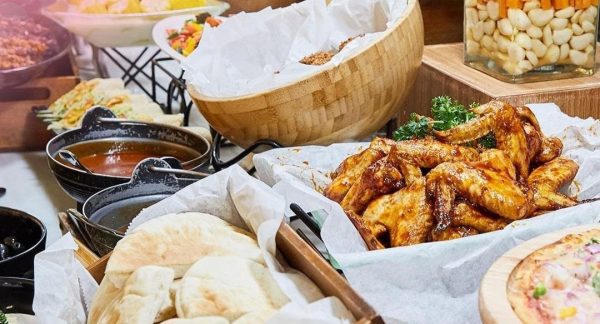
That logic becomes even stronger when the menu itself is broad. The Landmark’s buffet menus rotate across the week, with Menu A offered on Monday and Tuesday, Menu B on Wednesday and Thursday, and Menu C on Friday through Sunday. Across those menus, the restaurant lists salad bars, live stations, western items, seafood, local dishes, Indian selections, desserts, and beverages. Weekend dinners also add a live BBQ by the poolside. That kind of range is exactly what helps a group meal feel inclusive rather than negotiated.
Get halal assurance and guest comfort right
The smartest hosts ask the practical questions before they send the final invitation. These are the checkpoints that prevent awkward last-minute surprises:
- Verify that the restaurant displays its valid original MUIS halal certificate on site, and cross-check the outlet on the MUIS halal establishments listing.
- Make sure the certification applies to the exact outlet you are booking, because a new branch with the same name is not automatically covered until its own certification is issued.
- Ask whether the venue has prayer facilities if your booking runs across prayer times. Landmark states that it has prayer facilities or musollahs for events.
- If your group would prefer more privacy, ask whether the venue can provide segregated or subdivided space. Landmark’s event planning content specifically notes segregation possibilities for guests who need them.
- Clarify outside food rules before promising a birthday cake or desserts from elsewhere. MUIS notes that outside food is generally not allowed in eating establishments, including halal-certified ones, although this is usually company policy rather than a halal rule.
- Confirm accessibility details for elderly guests, children, and guests arriving by public transport. The Landmark is in Village Hotel Bugis at 390 Victoria Street, and the hotel’s official site lists Bugis MRT Station as a three-minute walk away.
This is the section that separates a smooth event from a stressful one. When guests feel that the host has thought about their comfort, the meal immediately feels more generous and more professional.
Build a menu everyone can enjoy
The easiest mistake in group dining is trying to choose one “perfect” cuisine for everyone. In real life, groups almost never work that way. Some guests want local comfort food, some want grilled items, some want seafood, and others just want something recognizable for children or less adventurous diners. A stronger strategy is to choose a halal restaurant where variety is already built into the dining format.
At The Landmark, that variety is fairly clear from the published menus. Menu A includes items such as satay, beef carving, chilli crab, tiger prawns, beef rendang, ayam bumbu, briyani rice, fish tikka, assorted naan, and more than 14 dessert options. Menu B and Menu C continue that same mixed-format approach with western, seafood, local, and Indian sections, while weekend dinner adds live BBQ items like roasted turkey, lamb carving, satay, tandoori chicken, fish tikka, prawns, and corn. For a host, that means you do not have to solve every taste preference manually; the menu has already done most of the work for you.
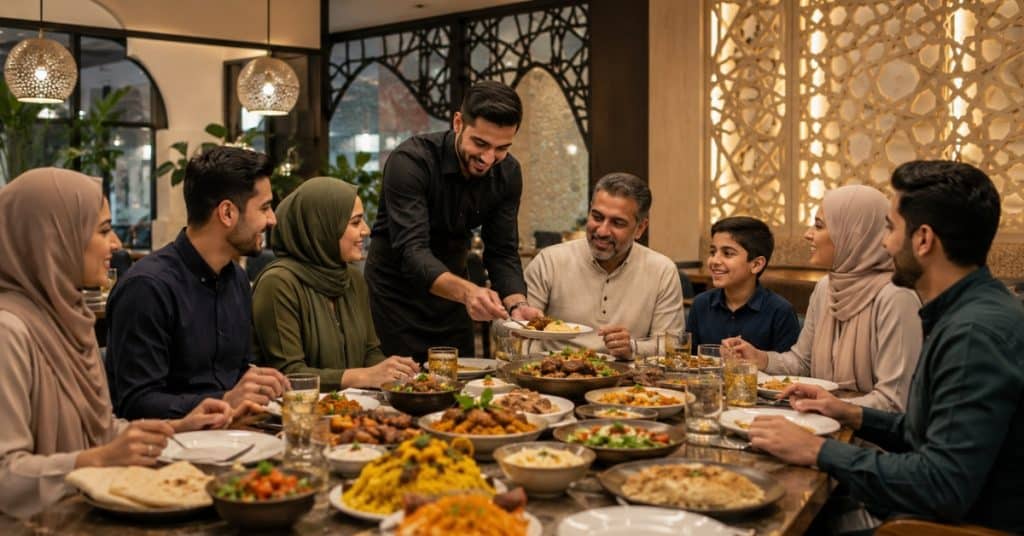
This is also where a halal buffet can help mixed social groups. Families, colleagues, and overseas visitors often bring different expectations to the same table. A venue with a clearly halal-certified setting and a wide international spread makes it easier to host everyone in one place without splitting the group across different restaurants or overcomplicating the order. The Landmark’s homepage explicitly positions the restaurant for family gatherings, corporate events, celebrations, and group seating, which aligns well with that use case.
Make the booking easy for the restaurant and your guests
A group dining experience usually becomes stressful when important information is scattered across too many messages. The simplest fix is to send the restaurant one clean booking brief instead of a stream of follow-ups.
The details worth sending at once
- Event type and dining style, such as birthday dinner, family reunion, company meal, or networking event.
- Expected headcount and whether you need standard seating, private space, or a larger event room.
- Preferred date and whether lunch or dinner works better for your guests.
- Guest needs, including prayer timing, elderly access, stroller access, children, or privacy preferences.
- Any event extras, such as AV support, speeches, slides, or celebration setup.
That kind of brief is especially useful when the meal is part of a larger function. Landmark’s event pages note built-in AV support, seminar requirements, and scalable event packages, which is exactly why giving the venue a full picture upfront tends to save time later.
Book earlier than you think you need to
For larger group bookings, early reservation is rarely a bad decision. Landmark’s own booking guidance says venues are often booked weeks or months in advance, and suggests about one month for gatherings of 40 to 50 people and one to two months for many events in the 50 to 80 range. Even if your event is more social than corporate, the planning principle still holds: early booking gives you better control over date, seating arrangement, and menu discussion.
Why The Landmark fits group dining in Singapore
If the goal is to make group dining feel easy rather than complicated, The Landmark has several practical advantages. It is located at Village Hotel Bugis, 390 Victoria Street, #05-01, and the hotel site places it a short walk from Bugis MRT, with Kampong Glam and other central Bugis attractions nearby. That location matters more than people think, because guests are more likely to arrive on time and with less friction when the venue is centrally placed.
The restaurant is also built around the exact features group organizers usually need: spacious seating for celebrations, an international halal buffet, different venue formats, and a setting already used for family gatherings, birthdays, corporate dinners, and larger events. For hosts who need more than a simple table booking, Landmark also publishes event-space capacities and corporate packages, which makes planning more straightforward.
On the dining side, the buffet has enough breadth to reduce compromise. The published menus cover local favorites, western dishes, seafood, Indian items, drinks, desserts, and selected live stations, and Friday-to-Sunday dinners add live BBQ by the poolside. In other words, it is a venue where the organizer can focus on the guest experience rather than trying to second-guess every appetite in advance.
For practical planning, The Landmark serves lunch daily from 12 PM to 2:30 PM and dinner daily from 6:30 PM to 10 PM, with reservations available through its website and direct contact channels.
Conclusion
A successful group dining experience at a halal restaurant is built on clarity. You need confidence in the halal status, a format that matches your headcount, a menu with enough range to keep the group together, and logistics that do not create stress for guests on the day. In Singapore, where halal certification should be verified rather than assumed, that planning mindset matters even more.
The restaurants that stand out for group dining are the ones that remove friction from the entire process. That means easy verification, flexible spaces, thoughtful guest comfort, and food that works across ages and preferences. For hosts planning in Singapore, The Landmark is a strong example of that model: halal-certified dining, published group-friendly spaces, wide buffet variety, and a central Bugis location that makes it easier to bring everyone to one table.
FAQs
How early should I book a group dining event?
For larger gatherings, earlier is better. Landmark’s own guidance suggests around one month for groups of 40 to 50 and one to two months for many events in the 50 to 80 range, especially when you need specific seating or spaces.
How do I verify that a restaurant is halal-certified in Singapore?
Check for the original halal certificate displayed at the outlet, then verify the outlet details on the MUIS halal establishments listing. The name and location should match.
Is a Muslim-owned restaurant automatically halal-certified?
No. MUIS states that halal certification is voluntary in Singapore. A Muslim-owned business may claim halal practices, but MUIS certification provides independent assurance.
Can I bring an outside cake or dessert for the event?
Maybe, but do not assume. MUIS says outside food is generally not allowed in eating establishments, including halal-certified ones, though this is usually company policy rather than a halal requirement. Always ask the venue first.
Why is The Landmark a good choice for group dining?
Because it combines halal-certified dining, broad buffet variety, central access in Village Hotel Bugis, group-friendly seating, and published event spaces for different gathering sizes.
Comments are closed.