
A practical starting point is five to seven savoury dishes alongside rice, with sambal, dessert and drinks counted separately. This gives you room for contrasting proteins, vegetables and a supporting side without making the selection unnecessarily large.
That range is a planning recommendation, not a fixed catering rule. A short office lunch may need fewer choices than a family celebration where guests have different tastes and dietary requirements.
The useful question is whether everyone can build a satisfying plate. Six carefully chosen dishes can achieve that more successfully than ten dishes dominated by similar meats, gravies and chilli levels.
Start with a Clear Dish Count
Before comparing packages, establish what “eight dishes” actually includes. Rice, dessert, drinks and condiments may all appear in a package’s item count, leaving fewer substantial savoury choices than expected.
For planning purposes, separate the menu into these categories:
| Menu component | Suggested starting point | Purpose |
| Rice | 1 option | Base for the meal |
| Main proteins | 2–3 dishes | Substantial choices with different flavours |
| Vegetables | 2 dishes | Variety beyond meat and seafood |
| Supporting side | 1–2 dishes | Additional texture or a dietary alternative |
| Sambal and condiments | Separately counted | Optional flavour and heat |
| Dessert | 1–2 options | Finish to the meal |
Choose within these ranges to reach five to seven savoury dishes. You do not need the maximum in every category.
When discussing Nasi Padang and event catering with The Landmark, request an itemised menu so the quotation clearly shows what is included.
Choose Proteins That Give Guests Different Options
Start with two proteins for a compact menu. Add a third when it serves a clear purpose, such as providing an alternative for guests who avoid beef.
Consider both the main ingredient and its preparation. Three different meats served in similarly rich sauces can still feel repetitive. A better combination offers differences in gravy, texture and seasoning.
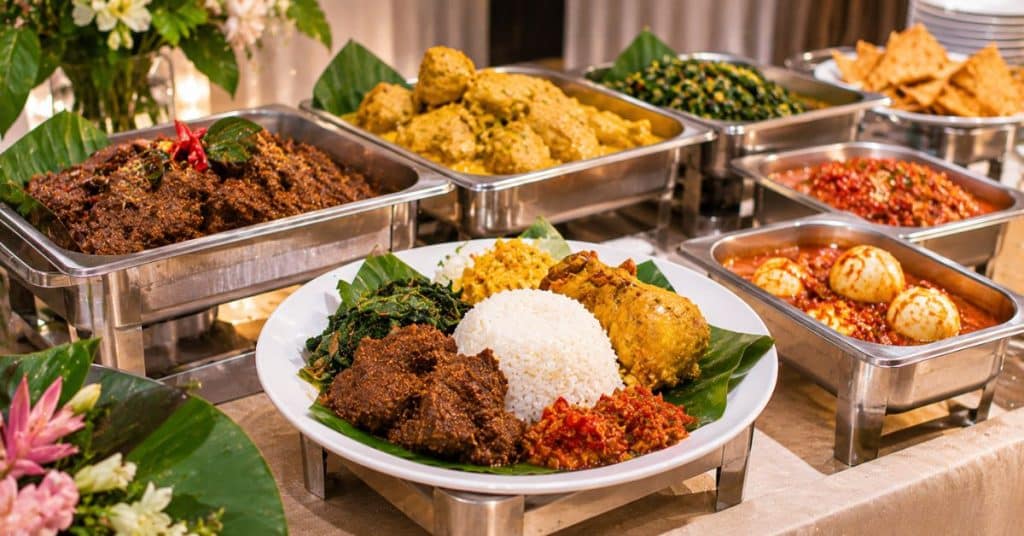
The Landmark’s published Royal Buffet Package lists Beef Rendang, Ayam Masak Merah and Nasi Putih within its Nasi Padang selection. These are useful dishes to discuss, although their inclusion in that published package does not establish availability for every event or delivery order.
If rendang is your rich centrepiece, ask which available chicken or fish preparation would provide contrast. Confirm the actual chilli level rather than assuming that chicken or fish will automatically be mild.
Give Vegetables Two Proper Places
For a six-dish savoury spread, allocating two places to vegetables is a useful way to avoid a menu dominated by meat.
Choose preparations that contribute different textures. One might offer a softer, saucier accompaniment, while the other provides a firmer bite. If both repeat the same heavy gravy, they add choice without much contrast.
The Landmark’s published Menu A includes Stir Fry Oyster Mushroom with Chinese Celery alongside Beef Rendang and Ayam Bumbu. This provides a concrete vegetable option to ask about when discussing your event menu; the restaurant buffet listing should not be treated as confirmation of catering availability.
Keep potato-heavy sides in perspective. They can be enjoyable additions, but selecting them should not automatically remove the menu’s other vegetables.
Check Whether Every Guest Can Make a Complete Plate
An impressive dish count can hide a practical gap. A vegetarian guest may still have little to eat if the rice contains meat stock and the vegetable dishes contain seafood ingredients.
Collect dietary requirements before finalising your selection. Ask about stocks, sauces, garnishes and cooking ingredients, rather than judging suitability from dish names.
Where required, discuss a suitable tofu, tempeh or other plant protein preparation. These are options to request, not assumed inclusions in The Landmark’s packages.
For a small number of guests with specific requirements, separately arranged meals may be more practical than expanding the entire buffet. Confirm preparation and serving arrangements directly, particularly where allergies are involved. A shared vegetable dish alone should not be treated as a complete dietary solution.
Balance Heat, Richness and Texture
Read your proposed menu across three dimensions: chilli, gravy and texture.
First, can someone who prefers less heat eat a complete meal? Plain rice and a small garnish are not enough. Aim to include an appropriate protein and vegetable option, with their seasoning confirmed.
Second, is every dish rich and saucy? Keep enough gravy to complement the rice, but consider a drier preparation where available.
Third, does everything have the same soft texture? A contrasting side can make the meal more varied without adding another substantial main.
Serving sambal separately gives guests some control over additional heat. It does not make an already spicy curry mild, so the core dishes still need careful selection.
Increase Quantity Before Increasing Variety
Guest numbers primarily change how much food you need. They do not automatically determine how many different recipes belong on the menu.
A larger group can still eat well from six savoury dishes if quantities, dietary coverage and replenishment are properly planned. Adding several extra dishes may spread the budget across more choices while leaving popular items short.
Ask the catering team how each dish is portioned. Chicken pieces, fish portions and prawns need different counting considerations from vegetables or gravy-based dishes.
Explain whether guests are likely to sample several proteins or expect a full portion of their favourite. Also identify any dish likely to attract unusually strong demand.
Do not divide the guest count equally between proteins without discussing serving assumptions. At a buffet, people may choose more than one.
Adjust the Selection to the Event Format
For a short working lunch, consider five savoury dishes: two proteins, two vegetables and one supporting side. A compact selection can make decisions and service simpler.
For a family celebration, six or seven may be worthwhile if the additional choices address different preferences. The extra dish should fill a gap, such as a suitable mild option, rather than repeat an existing flavour.
For packed meals, ask how the selected dishes fit into the containers. Multiple gravies can mix together, while too many components may leave each portion feeling small.
For a buffet with a tight meal break, discuss serving space and replenishment. Another tray of a popular dish may be more useful than another recipe.
Five Frequently Asked Questions
1. Is rice included in the recommended five to seven dishes?
No. Here, five to seven means savoury dishes served alongside rice. Confirm how the caterer counts items in its own packages.
2. Do I need chicken, beef and seafood?
No. Two suitable proteins can be enough. Add a third when it offers meaningful choice or accommodates your guest list.
3. Should a larger event have more dishes?
Not necessarily. Increase quantities and plan replenishment first. Add variety when guest preferences or dietary requirements justify it.
4. Does a balanced menu need two rice options?
Usually, one is sufficient as a starting point. A second rice option is worth considering only if it meets a clear preference or dietary need.
5. Can dessert replace a savoury dish?
It can occupy a package selection, but it does not fulfil the same role. Keep enough substantial food for the main meal before choosing desserts.